Description
Full Guide: How to Make Bouncy Balls
Why Parents Choose This
A Science Activity That Actually Works
No more crafts that fall apart or experiments that bore kids after 2 minutes. This kit is designed to delight from start to finish.
⚡ 5 Minutes, Real Results
Most science kits take forever to set up. This one takes 5 minutes and kids walk away with an actual toy they made themselves. The wow moment is guaranteed.
🛒 Supplies From Any Grocery Store
Borax, Elmer’s glue, cornstarch, food coloring. No specialty science stores, no Amazon wait times. You can do this experiment tonight.
🎓 Secretly Educational
Kids learn about polymers, chemical reactions, and cross-linking — without feeling like it’s a lesson. Parents love checking “STEM activity” off their list guilt-free.
🖨️ Print Unlimited Times
One purchase = forever access. Print it for every birthday party, every classroom, every rainy Saturday. It costs less than one pack of gum per use.
🏅 The Certificate Changes Everything
A simple certificate turns a fun activity into a proud memory. Kids want to frame it. Parents want to photograph it. It’s the detail that makes this kit unforgettable.
🎉 Perfect Party Activity
Set up a bouncy ball station at your next birthday party. Every child makes their own custom-colored ball AND takes home a certificate. Entertainment + party favor in one.
Made for Every Occasion
From birthday parties to classroom science demos — this printable kit works everywhere kids and curiosity meet.
🎂 Birthday Parties
Skip the boring goody bag. Set up a DIY bouncy ball station and let every guest make their own color. Entertainment + take-home gift in one.
🌧️ Rainy Day Activities
Print, gather three pantry supplies, and keep kids engaged for an entire afternoon. No screen time guilt included.
🏫 Classroom Science
Teachers love this as a polymer chemistry demo. The experiment tracker doubles as an assessment tool. Curriculum-aligned and mess-managed.
☀️ Summer Camp
A crowd-pleasing station for groups of 5 to 50. Every camper goes home with a ball they made and a certificate they earned.
🎁 Gift for Kids
Print and bundle with a bottle of Elmer’s glue and borax for a unique, affordable gift that beats any toy from the dollar bin.
🏠 Homeschool Curriculum
A hands-on polymer chemistry lesson that covers science vocabulary, observation skills, and the scientific method — all in one session.
What Families Are Saying
★★★★★
“I printed this for my daughter’s 7th birthday party and it was the HIGHLIGHT of the whole thing. Every kid made their own ball and took home their certificate. I got asked by three other moms where I found this.”
Sarah M.
Mom of 3 · Birthday Party Host · Verified
★★★★★
“Used this in my 2nd grade classroom as a polymer science intro. The experiment tracker was perfect — kids filled it in so seriously, like real scientists. The certificate at the end was priceless. Printing it again next semester.”
Ms. Torres
2nd Grade Teacher · Verified
★★★★★
“My 5-year-old and 9-year-old both loved it equally — which NEVER happens. The step-by-step card was easy enough that my older one could lead the whole thing. We’ve made bouncy balls three times now.”
Jake R.
Dad · Homeschool Parent
Why Making Bouncy Balls is the Perfect Kids Science Activity
What Makes a Bouncy Ball Bounce?
When white school glue (polyvinyl acetate) meets a borax solution, something remarkable happens: the borax molecules act as a cross-linker, bonding the long polymer chains in the glue together into a stretchy, solid network. This is called cross-linking, and it’s the same basic chemistry used to make rubber, slime, and even some types of plastic.
The cornstarch in this recipe helps bind the mixture, giving the ball a firmer texture and helping it hold its spherical shape during rolling. The result? A flexible polymer ball that stores elastic potential energy when compressed — and releases it as kinetic energy when it bounces back up.
What Kids Learn from This Experiment
- Polymer chemistry — how small molecules link into long chains
- States of matter — watching a liquid transform into a solid
- Chemical reactions — cause and effect in mixing substances
- Scientific observation — recording results in the experiment tracker
- Color mixing — primary color theory through food coloring
- Physics of elasticity — how stored energy creates a bounce
Is Borax Safe for Kids?
Borax (sodium tetraborate) is a naturally occurring mineral salt sold in the laundry aisle of most grocery stores. It has a long history of safe use in households and is considered safe for this type of craft activity with proper adult supervision. The key safety guidelines are simple: don’t ingest, wash hands after, and keep away from eyes. Our kit includes a clear safety guide on the recipe card.
For children with sensitive skin, thin disposable gloves can be worn during the mixing stage as an extra precaution.
Tips for the Best Bouncy Ball Results
- Use warm (not hot) water to help the borax dissolve fully
- Fresh Elmer’s school glue produces the bounciest results
- Roll the ball firmly and continuously — the more you roll, the smoother it gets
- Store in an airtight container to prevent drying out
- Add glitter for sparkly balls, or glow-in-the-dark paint for night-time fun
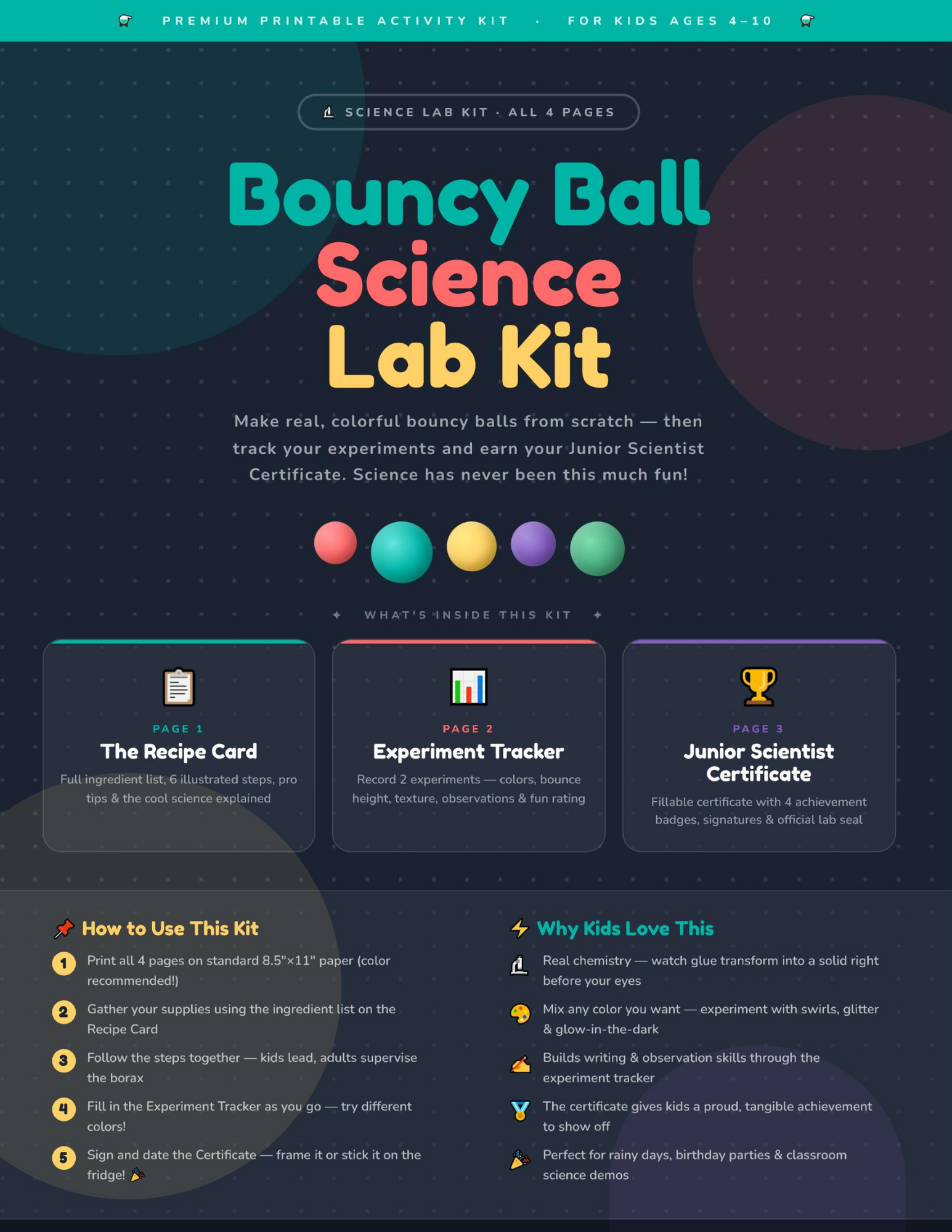
📦 What’s in the Kit
Everything you need in one instant download:
- Cover & intro page with how-to-use guide
- Full recipe card with 6 illustrated steps
- Pro tips, shortcuts & troubleshooting
- Kid-friendly science explainer
- 2-round experiment tracker
- Color mixing cheat sheet
- Junior Scientist Certificate
- 4 achievement badges
🛒 Supplies You’ll Need
All available at any grocery store:
- 1 tbsp Borax (laundry aisle)
- ½ cup warm water
- 2 tbsp white school glue
- 1 tbsp cornstarch
- Food coloring (optional)
- 2 small bowls + a fork
⚡ Quick Facts
- Time: 5 minutes per ball
- Age range: 4–10 years old
- Format: Instant PDF download
- Pages: 4 (8.5″ × 11″)
- Print: Unlimited, color or B&W
- Mess level: Moderate & manageable