
Scopa: Master the Sweep and Conquer Your Opponents! Craving a taste of Italy without the plane ticket? Scopa, meaning “broom” or “sweep” in Italian, is your gateway to a fast-paced, strategic trick-taking card game. Played in Italian piazzas for centuries, this classic combines simple rules with surprising depth, making it a favorite for casual players and seasoned card sharks alike. Typically played with 2 to 4 players, the objective isn’t just to sweep the table; it’s to outscore your opponents by capturing valuable cards and achieving those satisfying Scopas. Each round is a whirlwind of quick decisions, calculating captures, and strategically managing the table. Ready to learn how to play? Let’s dive into the rules!
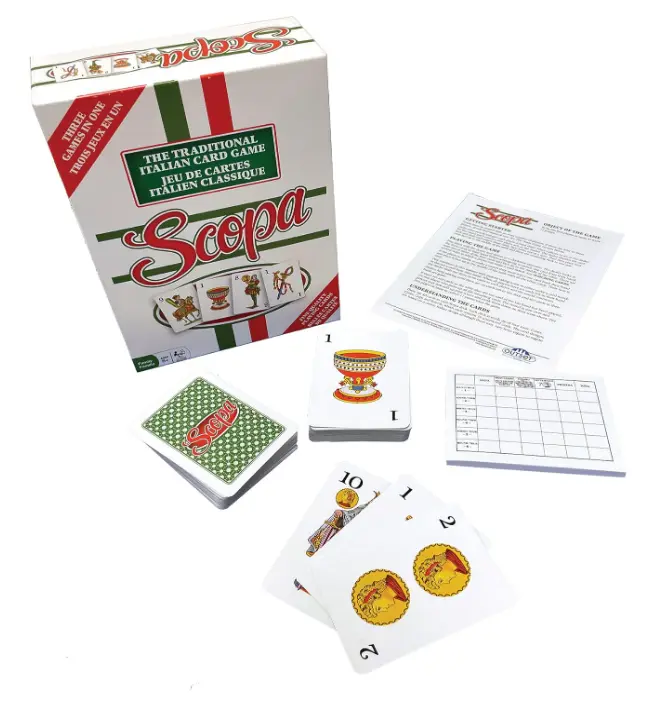
Preparing for Scopa: Deck and Deal
Before you can master the sweep in Scopa, you need to prepare the battlefield. This involves understanding the unique deck composition and the specific dealing procedures for various player counts.
The Scopa Deck: A 40-Card Italian Tradition
Scopa utilizes a distinctive 40-card Italian deck. Unlike a standard 52-card deck, the 8s, 9s, and 10s are removed. The four traditional Italian suits are:
- Denari (Coins): Represented by gold coins, discs, or other circular symbols.
- Coppe (Cups): Depicted as cups, goblets, or similar vessels.
- Spade (Swords): Illustrated as swords, blades, or other sharp weapons.
- Bastoni (Clubs/Batons): Represented by clubs, batons, or sticks.
Each suit contains the number cards Ace (1), 2, 3, 4, 5, 6, and 7, along with three face cards:
- Fante (Jack): Valued at 8.
- Cavallo (Knight/Horse): Valued at 9.
- Re (King): Valued at 10.
If a traditional Italian deck isn’t available, a standard 52-card deck can be adapted by removing all 8s, 9s, and 10s.
Dealing the Cards: Setting the Table
The dealing process differs slightly based on the number of players:
Two Players:
- Deal three cards face down to each player.
- Deal four cards face up to the center of the table. This forms the initial table layout and playing area.
Three Players:
- Deal three cards face down to each player.
- Deal four cards face up to the center of the table to establish the table layout and playing area.
Four Players (Partnerships):
- Players form partnerships, sitting opposite each other.
- Deal three cards face down to each player.
- Deal four cards face up to the center of the table to create the table layout and playing area.
The “King Overload” Scenario
If three or four Kings appear among the initial four face-up cards on the table, a “King Overload” occurs. This situation requires a re-deal because it makes achieving a Scopa (sweep) – a core element of Scopa gameplay – impossible. To maintain a fair and balanced game, gather all cards, reshuffle the deck thoroughly, and re-deal following the standard procedure.



Scopa Gameplay: A Trick-Taking Tussle

With the Scopa table set, it’s time to delve into the core mechanics of gameplay: capturing cards, achieving the coveted Scopa, and strategically managing your hand.
Capturing Cards: Two Paths to Victory
Gameplay in Scopa revolves around players taking turns to play one card from their hand to the table. Each card played aims to capture cards already on the table, forming tricks. There are two primary methods for capturing cards:
- Matching: If the numerical value of your card matches a single face-up card on the table, you capture that card. If multiple matching cards are on the table, you choose which one to capture and add both cards to your score pile. This forms a trick.
- Totaling: If your card’s numerical value equals the sum of two or more face-up cards on the table, you capture all cards in that combination, adding them to your score pile to form a trick. If multiple totaling combinations exist, you choose which set of cards to capture.
Key Rule: Matching Takes Priority
If your played card matches a single card on the table, you must capture that single card, even if a totaling combination is available. This fundamental rule prevents players from manipulating the table and ensures a consistent and fair game flow.
Scopa!: Sweeping the Table Clean
Achieving a Scopa is a key objective in Scopa. A Scopa occurs when your played card captures all remaining cards on the table, leaving it empty. This not only earns you a bonus point and adds the captured cards to your score pile but also forces the next player to play a card without the opportunity to capture anything. To mark a Scopa, place the capturing card face up and perpendicular to the other captured cards in your score pile.
Continuing the Round: Dealing and Capturing
After each player plays their initial three cards, the dealer deals three more cards face down to each player. This continues until the entire deck is depleted. Importantly, no additional cards are dealt face up to the table after the initial four cards.
Ending the Round: Last Capture Bonus
When all cards have been played, any remaining face-up cards on the table are awarded to the player who made the last capture, adding them to their score pile. It’s important to remember that capturing these last cards does not qualify as a Scopa, even if it clears the table.
Scopa Scoring: Calculating the Victor

After the exhilarating card play, it’s time to tally the points and determine the winner. Scopa’s scoring system is a blend of straightforward point accumulation and a unique card evaluation method called Primiera.
Point Breakdown: Earning Points in Scopa
Points are awarded in Scopa based on several criteria:
- Scopa: Each Scopa achieved during a round of play earns 1 point. Remember, capturing the remaining cards at the very end of a round does not constitute a Scopa.
- Most Cards (Cards Point): The player or team who captures the majority of the cards at the end of the round receives 1 point. In partnership games, teams combine their captured cards. If there’s a tie, neither player/team earns this point.
- Most Coins (or Diamonds) (Coins Point): Capturing the most cards of the Coins suit (or Diamonds if using a French-suited deck) earns 1 point. If tied, no point is awarded. In team play, partners combine their Coins/Diamonds cards.
- Sette Bello (Beautiful Seven): Capturing the Seven of Coins (or Diamonds) automatically grants 1 point.
Primiera: The Strategic Card Combination
Primiera is a distinct scoring element in Scopa, requiring players to strategically assemble card combinations for bonus points. Each player or team (with combined cards in partnership games) aims to create the highest-value combination of four cards, one from each suit.
The card values for Primiera differ from their capture values during gameplay:
| Card | Primiera Value |
|---|---|
| Seven | 21 |
| Six | 18 |
| Ace | 16 |
| Five | 15 |
| Four | 14 |
| Three | 13 |
| Two | 12 |
| Face Cards | 10 |
Example: A player with a Seven of Coins (21), a Six of Cups (18), an Ace of Swords (16), and a Five of Clubs (15) would have a Primiera score of 70.
To calculate the Primiera point:
- Each player or team (with combined hands in partnerships) selects one card from each suit in their captured cards. If a player or team lacks a card from any suit, they are ineligible for the Primiera point.
- Players total the Primiera values of their chosen four-card combinations.
- The player or team with the highest total Primiera value earns 1 point. A tie results in no point being awarded.
Winning the Game: Target Score and Tiebreakers
Scopa is typically played to 11 points, but the target score can be adjusted by prior agreement. The game continues over multiple rounds until a player or team reaches or surpasses this target. If multiple players/teams reach the target in the same round, the highest score wins.
Tiebreaker Scenarios:
- Tie at the Target Score: If players/teams are tied at the target score (e.g., 11 points), an additional round is played to break the tie.
- Tie Above the Target Score: In the event of a tie above the target score, the player or team with the highest score wins. If scores remain tied, continue playing rounds until a clear winner emerges.
Exploring Scopa Variations: From Asso Pigliatutto to Scopone

While classic Scopa provides a robust foundation, a multitude of regional and adapted variations offer diverse and engaging gameplay experiences. These alternative rulesets introduce unique twists, strategic depths, and cultural flavors to the core Scopa mechanics, ensuring the game remains fresh and exciting for players of all levels.
Popular Variations:
Asso Pigliatutto (Ace Takes All): This widely played variation simplifies capturing. By playing an Ace, you capture all cards on the table, scoring a Scopa point – unless another Ace is already present. In that case, the played Ace captures only the existing Ace.
Scopa d’Assi (Scopa of Aces): Similar to Asso Pigliatutto, playing an Ace captures all cards on the table. However, in this variant, clearing the table with an Ace does not constitute a Scopa and therefore doesn’t award a point.
Scopa di Quindici (Scopa of Fifteen): This mathematically-inclined variation introduces a target number for captures. Three main versions exist:
- Version 1 (Strict Fifteen): Capture is restricted to card combinations that, when added to the played card’s value, total exactly 15. Matching individual card values is not permitted.
- Version 2 (Fifteen or Match): Players have the option to capture cards either by matching values or by forming combinations that sum to 15.
- Version 3 (Fifteen, Match, and Ace Sweep): This version combines the flexibility of Version 2 with the Ace-sweeping power of Asso Pigliatutto. Clearing the table with an Ace in this version does score a Scopa.
Less Common but Equally Engaging Variations
- Scopa con le Scalette (Scopa with Little Ladders): Expanding on the Napola concept, this variation offers bonus points for specific sequences of Coins or Diamonds called Scalette.
- Scopa Bazzica: This two-player variation adds a “declaration” mechanic where players can score bonus points for certain three-card combinations in hand.
- Scopa Corse (Corsican Scopa): Distinctively, Scopa Corse removes the mandatory capture rule, allowing players to choose whether or not to capture available cards, even if a match or combination is possible. This introduces elements of bluffing and strategic card retention.
- Chkobba (Tunisian Scopa): This North African adaptation features anticlockwise gameplay and modified scoring, including a simplified Primiera.
- Hurrikan (German Scopa): Hurrikan offers a faster-paced Scopa experience with larger hands (6 cards), fewer deals, and Hearts as the bonus suit.
- Scopone (Big Scopa): Traditionally played with four players in partnerships, Scopone involves dealing all the cards at once, creating larger hands and expanding opportunities for strategic plays and declarations.
Scopa Strategy: From Beginner to Campione

Scopa is far more than a game of chance. Strategic thinking, astute observation, and tactical card play significantly increase your chances of victory. Elevate your Scopa game from novice to campione (champion) with these essential strategies:
Mastering the Scopa
While consistently capturing cards is important in Scopa gameplay, remember that a Scopa itself is worth a valuable point. Don’t rush to play high-value cards early in the hand, even if they offer an immediate capture. Instead, exercise patience and strategically hold onto those cards to create opportunities for a table-sweeping Scopa later in the round. For instance, if the table shows a King and a Four, holding onto your Six could set you up for a Scopa on a later turn. This patience also denies your opponents potential Scopas, disrupting their point-scoring strategy.
Table Management: Offense and Defense
Effective Scopa strategy requires controlling the table layout. Adopt a two-pronged approach: offense and defense. Offensively, manipulate the table to create Scopa opportunities for yourself. This involves carefully selecting which cards to play and which combinations to leave on the table, engineering totals that only you can capture with cards remaining in your hand. Defensively, anticipate your opponents’ potential Scopas. If you notice an opponent collecting Fives and Sixes, be wary of leaving combinations totaling 11 on the table. Disrupt their plans by capturing crucial cards or creating less favorable totals, forcing them into suboptimal plays.
Decoding Your Opponents: The Power of Observation
Scopa rewards attentive players. Carefully observe the cards your opponents capture. This provides crucial insights into their hands, potential strategies, and Primiera combinations. Are they favoring a specific suit for a potential Napola? Are they hoarding high-value cards for a late-game Primiera push? This knowledge is power, enabling you to predict their moves, block their Scopa attempts, and strengthen your own hand. In partnership games, communicating these observations with your partner allows for coordinated plays and maximizes your team’s winning potential.
Sette Bello: A Strategic Advantage
The Sette Bello (Seven of Coins/Diamonds) is more than just an automatic point; it’s a strategic asset. Capturing it early disrupts opponents aiming for Napolas (sequences) in variations where these are valuable. Additionally, the Sette Bello strengthens your Primiera hand, especially if you’re short on high-value Coins/Diamonds.
Primiera Mastery: Building a Balanced Hand
Constructing a winning Primiera hand requires balance and foresight. While high-ranking cards like Sevens and Sixes are essential for maximizing your Primiera score, consider capturing lower-ranking cards strategically, especially in the early game. A well-rounded Primiera hand requires at least one card from each suit. A strategically captured Two or Three can complete a suit in your Primiera hand while simultaneously denying your opponent the same opportunity, potentially earning you the Primiera point even with a lower overall score. This long-term Primiera strategy is often more effective than simply chasing the highest individual cards.
FAQs
Can I capture multiple sets of cards with a single card?
No. In standard Scopa rules, each card played can only capture one card or one combination of cards totaling the played card’s value. Choose your capture strategically!
What happens if I cannot capture any cards on my turn?
If you can’t make a capture, your played card remains on the table. This adds to the available cards for future captures by you or your opponents.
Is the Seven of Coins (or Diamonds) always worth a point?
Yes, capturing the Sette Bello (Seven of Coins/Diamonds) always awards one point, regardless of other scoring conditions.
Can I choose not to capture cards if a match or total is available?
In standard Scopa, capturing is mandatory. If a match or a totaling combination exists, you must capture cards. However, variations like Scopa Corse offer optional capturing, adding a layer of strategic complexity.
Do the last cards captured on the table at the end of the round count as a Scopa?
No. Capturing the last cards of the round, even if it clears the table, does not count as a Scopa.
What is a “Napola,” and how does it affect scoring?
A Napola refers to sequences of Coin/Diamond cards. The specific scoring for Napolas depends on the Scopa variation being played.
Does the Ace always capture all cards in Asso Pigliatutto?
In Asso Pigliatutto, an Ace captures all cards on the table unless another Ace is already present. If an Ace is already on the table, the played Ace captures only the other Ace.
Want more card game fun? Check out our curated lists for couples, 1 player, 2 players, 3 players, 4 players, 5 players, and 6 players card games!
As an Amazon Associate, we may earn a commission from qualifying purchases at no additional cost to you.
