
Looking for a card game that works for literally everyone at the table – from your card-shuffling toddler to your competitive teenager to Grandma who “doesn’t really like games”? Help Your Neighbor is about to become your family’s new obsession. This brilliant mix of luck, strategy, and good old-fashioned kindness has been bringing families together since your grandparents were kids, and for good reason: it’s ridiculously fun.
Here’s what makes this game so special: the “helping” mechanic means players are constantly passing luck around the table, which keeps everyone engaged and creates this wonderful sense of teamwork even though you’re technically competing. Plus, it’s got that perfect balance of simple rules and exciting gameplay that makes it a hit with every age group.
Best for: Family game nights, teaching young kids card games, multi-generational gatherings
Players: 4-8 players (works with 3, but shines with 4+)
Ages: 4 to 99 (seriously!)
Time to Play: 20-45 minutes depending on rounds
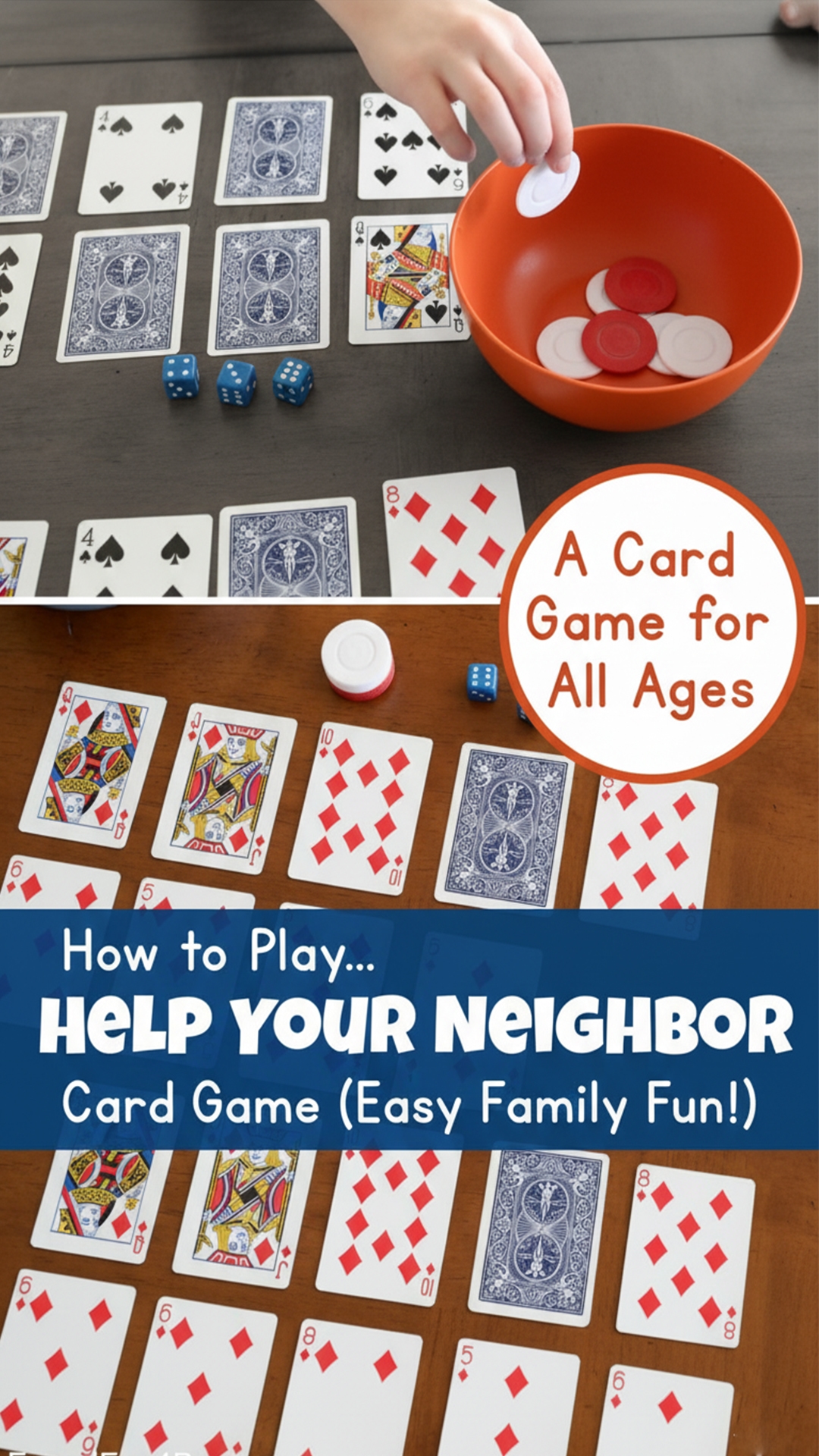
What You’ll Need:
1-2 decks of standard playing cards
2 dice
Poker chips (or coins, buttons, dried beans – anything you can count)
A bowl or container for the “pot”
How many chips per player? Start with 10 chips each for younger kids or shorter games. Give everyone 15 chips if you want the game to last longer and get more competitive.
Setup: Getting Your Game Ready
Before you dive in, you’ll need to prep your deck:
1. Remove all Kings, Aces, and 7s from your deck (you won’t need Jokers either)
2. Each player gets 10 cards from the same suit. This is key – one player gets all the hearts, another gets all the spades, and so on. You’ll need cards 2 through Queen (that’s 10 cards total since the 7 is removed)
3. Arrange your cards face-up in front of you in numerical order: 2, 3, 4, 5, 6, 8, 9, 10, Jack, Queen
4. Grab your chips! Each player starts with the same number (10 or 15)
5. Set out the pot in the center where everyone can reach it
How to Play: Here’s Where the Magic Happens
Starting the Round
Every player tosses one chip into the pot to kick things off. This builds the prize pool and gets everyone invested right from the start.
Taking Your Turn
Player 1 rolls both dice and adds them together. Let’s say you roll a 4 and a 5 – that’s 9. You flip over your 9 card. Easy!
But here’s where it gets interesting…
The “Help Your Neighbor” Rule (This Is Everything!)
Roll a number you’ve already flipped over? Don’t worry – your roll doesn’t go to waste! It automatically goes to the next player clockwise who still needs that number. That player gets to flip their card over AND roll the dice for their own turn.
This means:
- Turns bounce around the table in unpredictable ways
- Everyone stays engaged because you might get a bonus turn at any moment
- The game moves fast because players aren’t just waiting for their “official” turn
What about face cards? Jacks count as 11, Queens count as 12.
The Dreaded 7 Rule
Remember how you removed all the 7 cards? That’s because rolling a 7 means you pay the pot. Throw one chip in, and your turn ends immediately. (This is why the pot keeps growing and makes winning so satisfying!)
When Nobody Needs Your Roll
As the game progresses, you’ll eventually roll a number that everyone’s already flipped. When this happens, keep rolling until you get a number someone can use – even if that someone is you!
Winning the Round
First player to flip all their cards wins the round! Here’s where it gets rewarding:
1. Every other player counts their face-up cards still showing
2. Each player puts one chip in the pot for every card they have left
3. The winner takes the entire pot!
Then start a new round with whatever chips everyone has left.
Winning the Game
Keep playing rounds until players run out of chips. The last player standing with chips wins the game!
Pro Tips from Families Who’ve Played This for Generations
For younger kids (ages 4-6): Use just one die and cards 2-6. When they roll a 1, that’s when they put a chip in the pot. This simplified version teaches counting and turn-taking without overwhelming little ones.
Encourage good manners: Make it a rule to say “Thanks, neighbor!” when someone’s roll helps you. It’s a small touch that makes the game feel even more collaborative and teaches gratitude.
Can’t find poker chips? Raid your pantry! Dried beans, pasta shapes, buttons, pennies, or even small candies work perfectly. The M&M version is particularly motivating for kids (just set a rule about when they can eat their “chips”).
For preschoolers: Skip the pot entirely and just race to flip all your cards first. The winner gets to be “dealer” for the next round.
Mix up the chip count: If you’ve got experienced players and newbies at the same table, give the newer players a few extra chips to start. This levels the playing field and keeps everyone in the game longer.
Why Families Keep Coming Back to This Game
There’s something magical about a game where helping others is literally built into the rules. Kids learn strategic thinking (which cards to hope for) while also experiencing the joy of being helped by others’ “unlucky” rolls.
The pace is quick enough that nobody gets bored, but there’s enough luck involved that a four-year-old has a genuine shot at beating the adults. And because chips change hands dramatically at the end of each round, comebacks are always possible – nobody’s ever truly out until they’re completely out of chips.
Plus, that satisfying moment when you flip your final card and claim a massive pot of chips? Chef’s kiss. Pure family game night gold.
Ready to start a new tradition? Grab those cards, round up the family, and get ready to help your neighbors!
More Kid’s Party Ideas to Keep the Fun Rolling:
Paper Airplane Birthday Party Ideas That’ll Have Your Guests Soaring
Cornstarch & Dish Soap Bubble Dough: Easy DIY Sensory Fun!
25+ Hands-On Human Body STEM Activities Kids Will Love
The Soap and Pepper Experiment: A Mind-Blowing Way to Get Your Kids to Actually Use Soap
How to Make a DIY Kaleidoscope: A Mind-Blowing Science Craft for Kids
15 Minions Party Ideas For The Ultimate Despicable Me Birthday Bash
How to Make Magic Unpoppable Bubbles That’ll Blow Your Kids’ Minds
