
Planning a safari-themed learning week and need activities that actually keep little hands busy? You’re in the right spot! We’ve rounded up the best safari fine motor activities that combine hands-on fun with serious skill-building – no boring worksheets required.
From sensory bins that spark imagination to challenges that build patience and coordination, these activities are designed to make learning feel like playtime. And here’s the best part: most of these use stuff you already have lying around the house!
Whether you’re a parent looking for after-school activities or a teacher planning your preschool safari unit, these ideas will have your little explorers developing crucial fine motor skills while having an absolute blast. Let’s dive into the wild side of learning!
1. Safari Scavenger Hunt
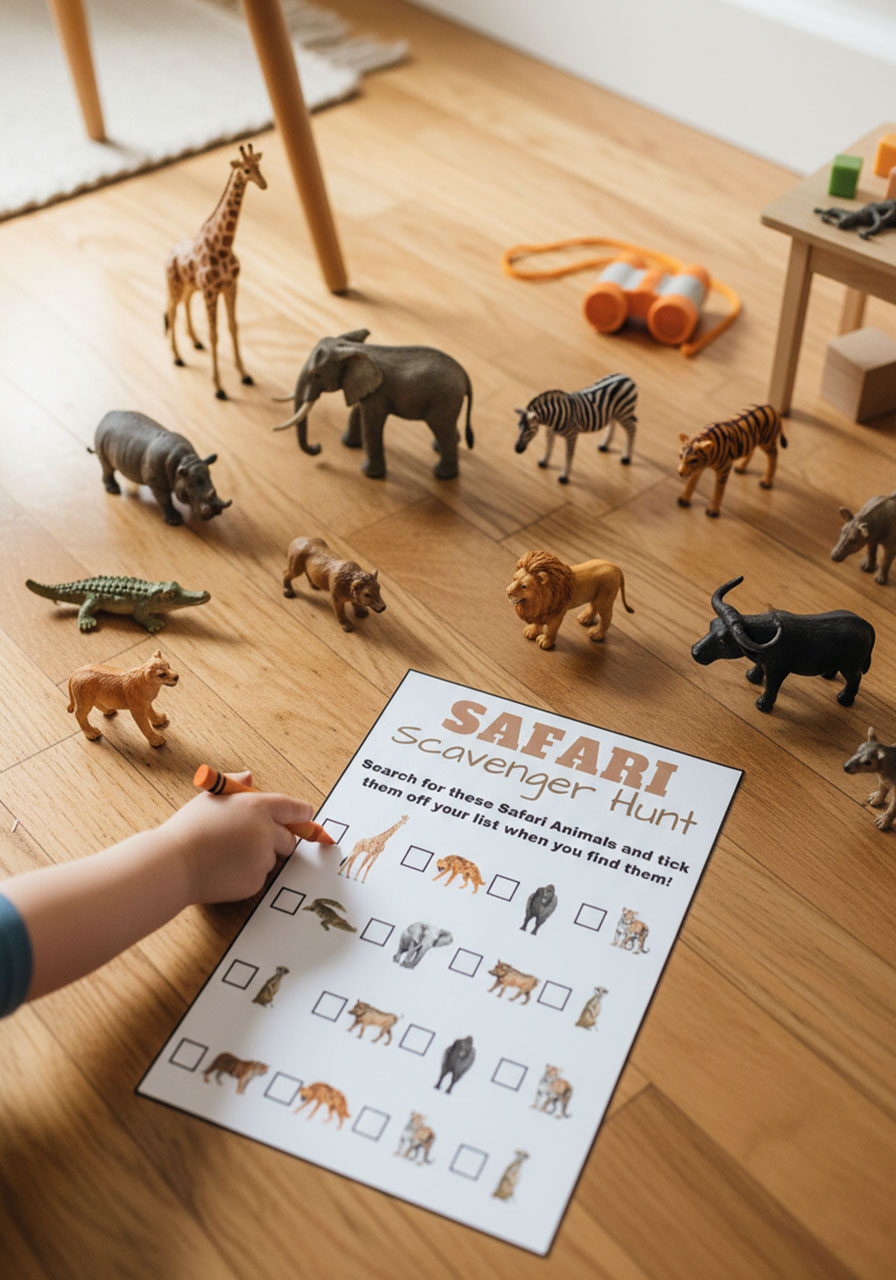
Turn your space into an exciting safari expedition with this active scavenger hunt! This one’s perfect for kids who learn best when they’re on the move.
Best for: Preschoolers and early elementary, indoor or outdoor play
Skills Developed: Observation, concentration, animal recognition, checking/marking skills
What You’ll Need:
- Safari animal toys or figurines
- A checklist with animal pictures (you can draw simple ones!)
- Pencil or crayon for checking off finds
- Optional: Binoculars for extra safari vibes
How to Set It Up:
1. Create your animal checklist by drawing or printing simple pictures of safari animals (lions, elephants, zebras, giraffes, hippos, etc.) with a checkbox next to each one.
2. Hide the animals around your room, house, or outdoor area. Make some easy to spot and others more challenging based on your kids’ ages.
3. Hand out the checklists and send your little safari explorers on their adventure! They’ll search for each animal and check it off when found.
4. For an extra challenge, have them match the animals to the pictures on the checklist without any words – this builds visual recognition skills.
Pro Tip: If you don’t have toy animals, cut out animal pictures from magazines or draw them on paper, then hide those instead! You can also turn the pictures themselves into the items to find by cutting them into squares and hiding them around the space.
2. DIY Safari Sensory Bin
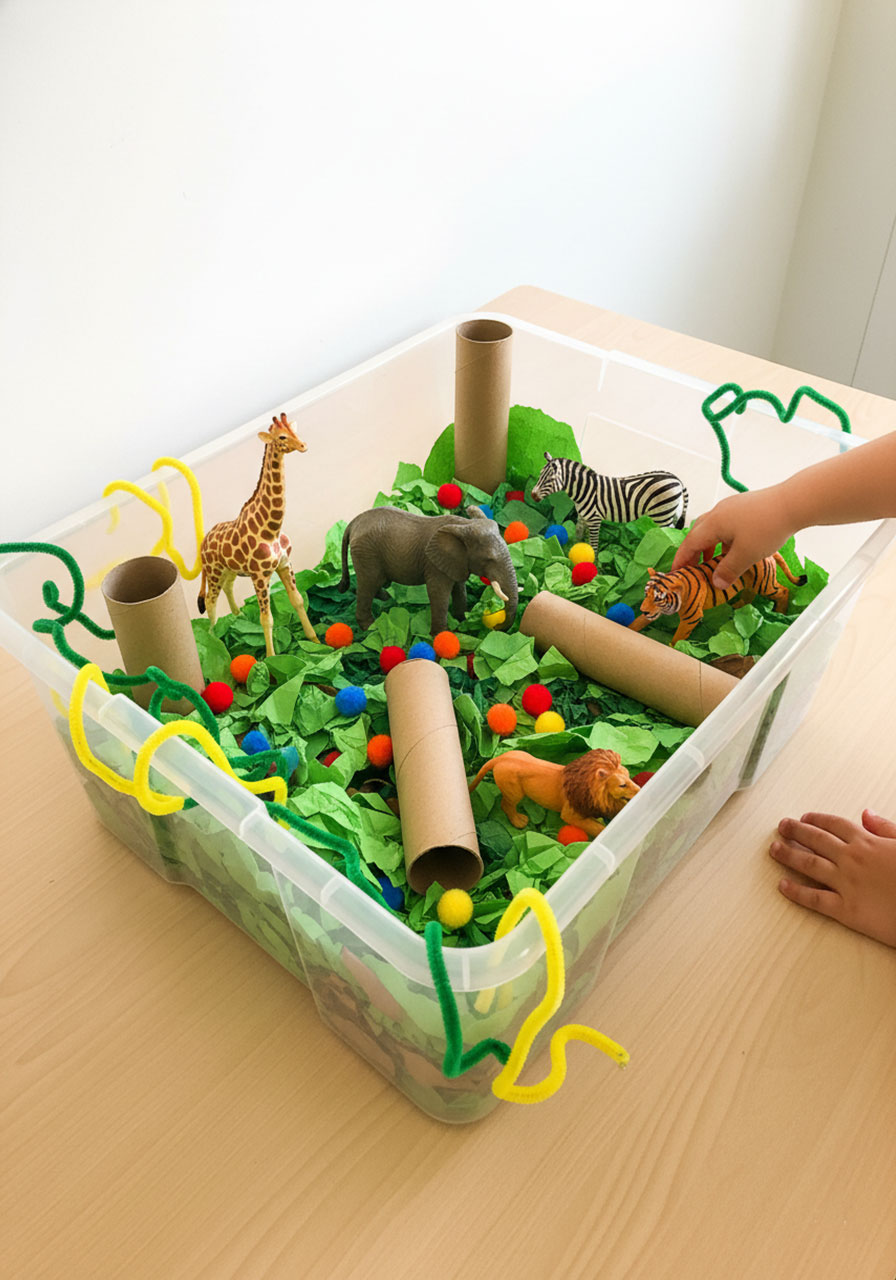
This is hands-down one of the easiest and most engaging activities you can throw together – and it’s perfect for using up craft scraps!
Best for: Toddlers through preschool, creative play
Skills Developed: Imaginative play, fine motor manipulation, sharing, language development
What You’ll Need:
- A plastic tub or large container
- Colored paper (greens and browns work great for grass and dirt)
- Tissue paper in various colors
- Empty toilet paper or paper towel rolls
- Mini pom poms
- Pipe cleaners
- Safari animal toys
How to Set It Up:
1. Layer your base by placing colored paper at the bottom of your tub.
2. Add texture by scrunching up tissue paper and spreading it around to create a wild landscape.
3. Create trees and logs using those cardboard tubes – stand them up or lay them down.
4. Scatter the extras like pom poms (they can be anything – berries, rocks, you name it!) and pipe cleaners (perfect for vines or snakes).
5. Add your safari animals and let the kids take over! The beauty of this activity is that they decide what everything becomes.
Pro Tip: Don’t stress about making it look perfect – the kids will rearrange everything in about 30 seconds anyway! The goal is to give them a starting point that sparks their creativity.
3. Safari Animal Tower Challenge

Ready to test those patience skills? This simple stacking challenge is surprisingly addictive for kids AND adults!
Best for: Preschool and up, solo or paired play
Skills Developed: Hand-eye coordination, balance, patience, problem-solving, spatial awareness
What You’ll Need:
- Safari animal figurines (varying sizes work best)
- A flat, steady surface
How to Play:
1. Set the challenge: Who can build the tallest tower using only safari animals?
2. Let them experiment with different stacking strategies. Which animals are easier to balance? Which ones make the best base?
3. Try variations:
- Who can balance the most animals before the tower falls?
- Can you create a tower using only 5 animals?
- Challenge: Build a tower where each animal is smaller than the one below it!
Pro Tip: If your animals keep sliding, this is actually a great problem-solving opportunity! Talk through it with your kids: “Why do you think the lion keeps sliding off? What could we try instead?” These little moments build critical thinking skills.
4. Feed the Hungry Safari Animals
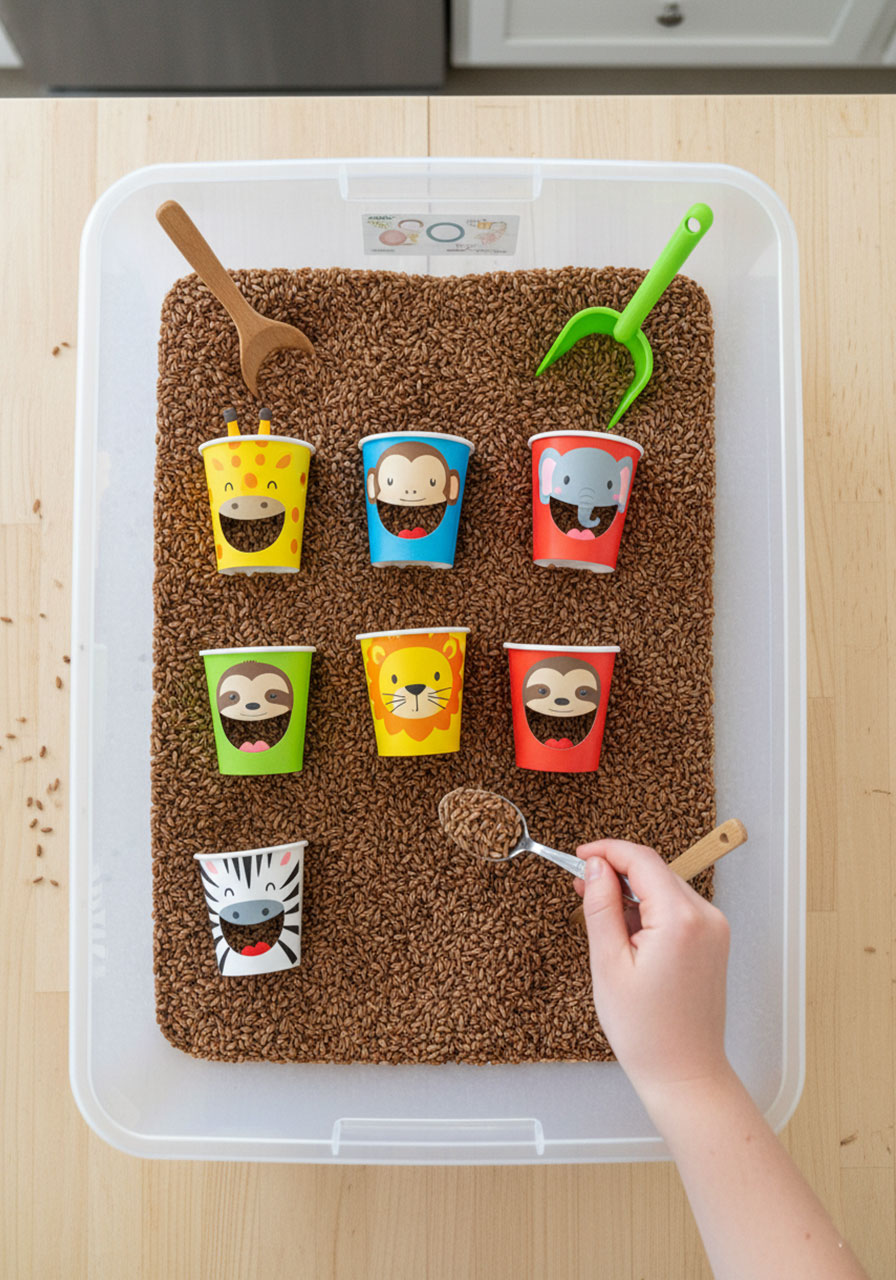
This cutlery practice activity is pure genius for kids who are still mastering spoons and forks!
Best for: Ages 2-5, great for occupational therapy practice
Skills Developed: Utensil grip and control, scooping, coordination
What You’ll Need:
- A large tub or container
- Sensory filler (dyed rice, dry beans, cereal, or pom poms)
- Small bowls or cups (bonus points if you can add safari animal faces!)
- Spoons, small shovels, or kid-safe tweezers
- Optional: Printable animal faces to attach to cups
How to Set It Up:
1. Fill your container with your chosen sensory material.
2. Place the “feeding bowls” around or inside the container – these are where the animals will “eat.”
3. Give your child the utensils and explain that the safari animals are hungry and need to be fed!
4. Let them scoop the filler into the animal bowls. It’s trickier than it sounds – rice and pom poms love to escape!
Pro Tip: Start with spoons, then progress to using a knife and fork together for an extra challenge. And if you need this to be taste-safe for younger kids, use cereal or cooked pasta instead of rice or beans.
5. Rescue the Safari Animals
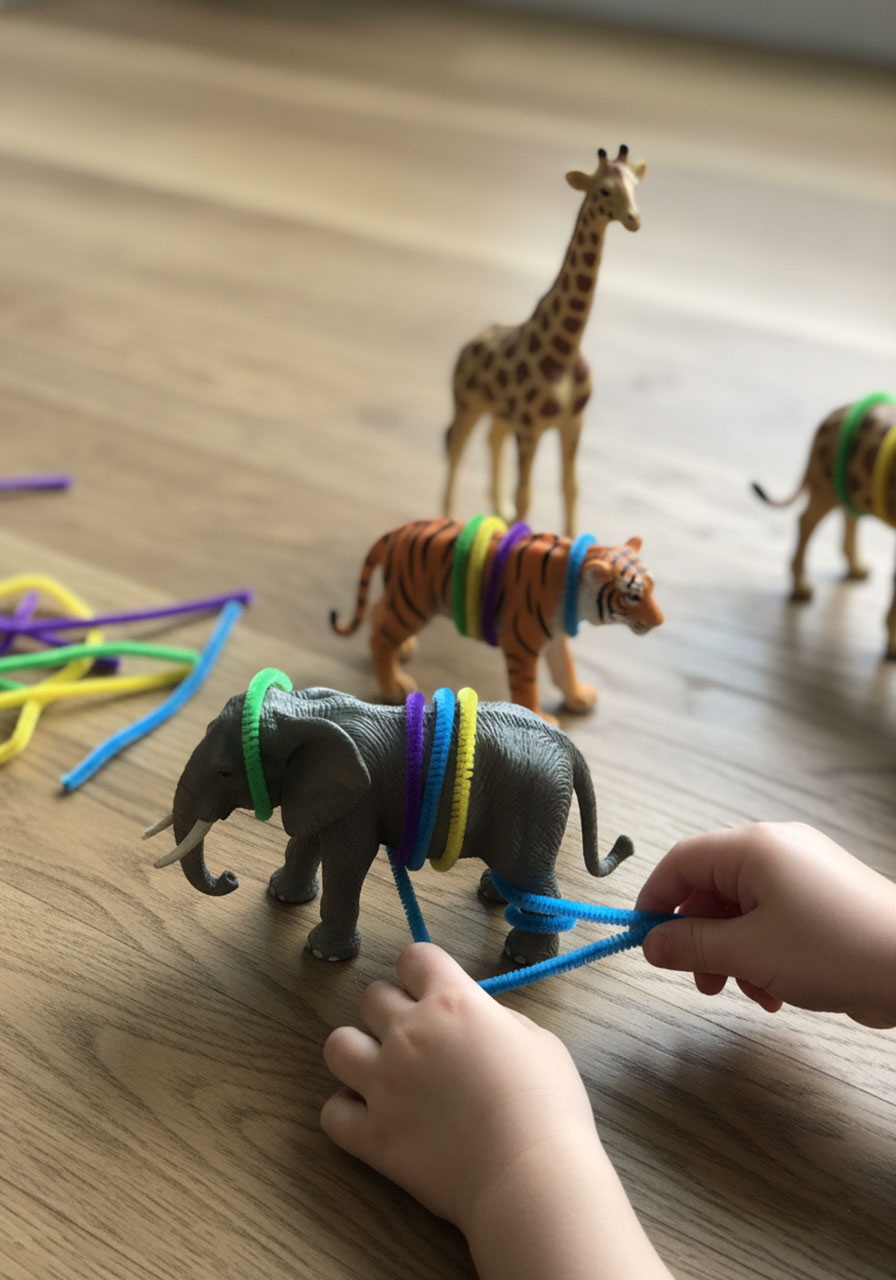
Wake up to this activity setup, and your kids will think you’re the coolest parent or teacher ever!
Best for: Ages 3-6, morning surprise activity
Skills Developed: Fine motor precision, problem-solving, persistence
What You’ll Need:
- Safari animal toys
- Colorful pipe cleaners
- A flat surface or small container
How to Set It Up:
1. Wrap each animal loosely with pipe cleaners while your kids are asleep or before they arrive at school – make it look like the animals are “trapped”!
2. Set the scene in the morning with a little story: “Oh no! The safari animals got tangled up in vines overnight! Can you help rescue them?”
3. Let them work to carefully unwrap and free each animal. Those little fingers will get a serious workout!
Pro Tip: Vary the difficulty by how tightly you wrap the pipe cleaners. Younger kids need looser wrapping, while older kids can handle a tighter challenge. You can even add a timer for kids who love a good race against the clock!
6. Two-Minute Safari Sensory Bin
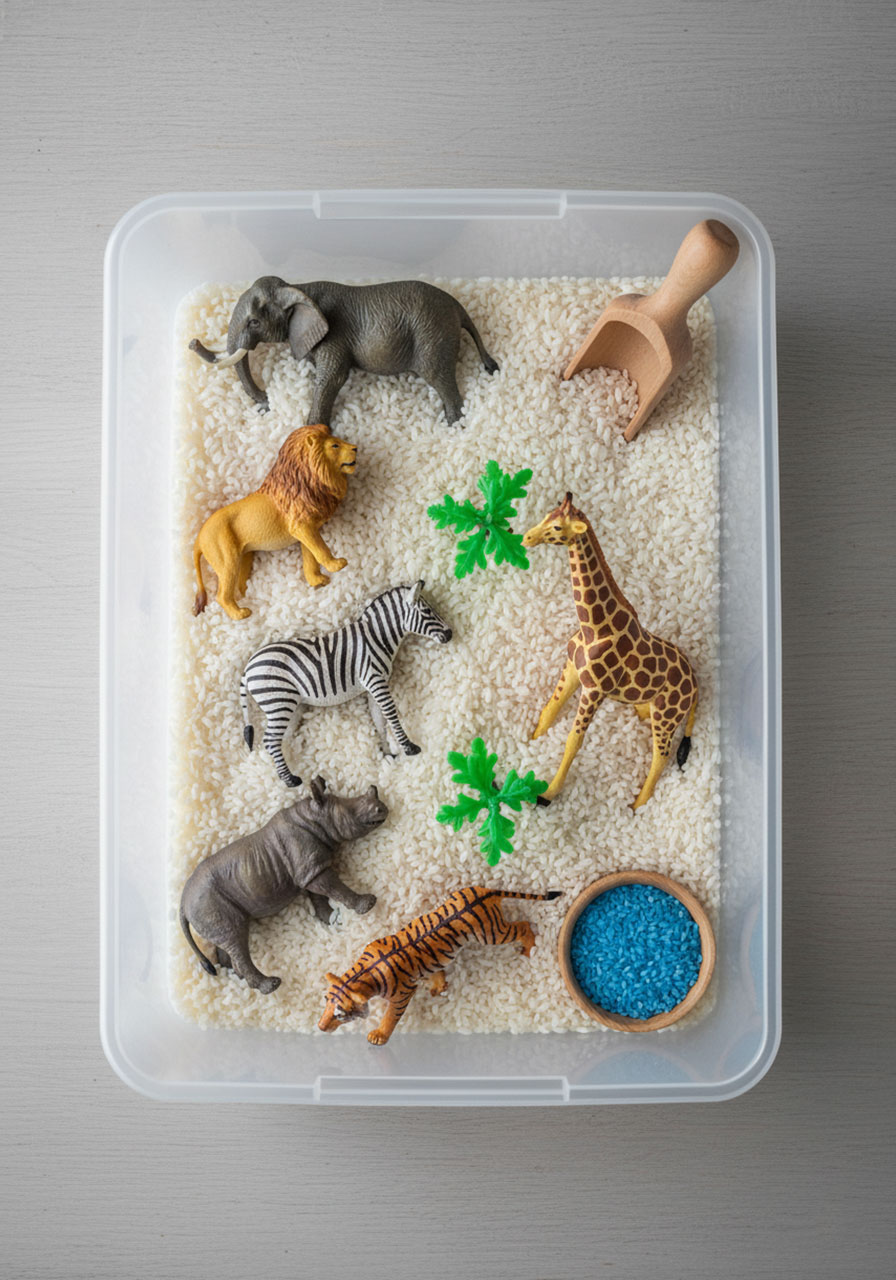
Running late but need an activity ASAP? This is your new best friend.
Best for: All ages, emergency entertainment
Skills Developed: Sensory exploration, imaginative play, categorization
What You’ll Need:
- Rice (any color, but mixing colors looks cool)
- A container
- Safari animal toys
- Optional: Small trees, rocks, or a dish of “water” (blue rice in a small container)
How to Set It Up:
1. Dump the rice into your container.
2. Add the animals and any other extras you have.
3. You’re done! Seriously, that’s it.
Your kids will create their own safari adventures from here. Sometimes the simplest setups lead to the most creative play!
Pro Tip: Keep a “sensory bin kit” in a labeled container with rice and animals ready to go. Future you will be so grateful when you need something fast.
7. Size Sorting Safari
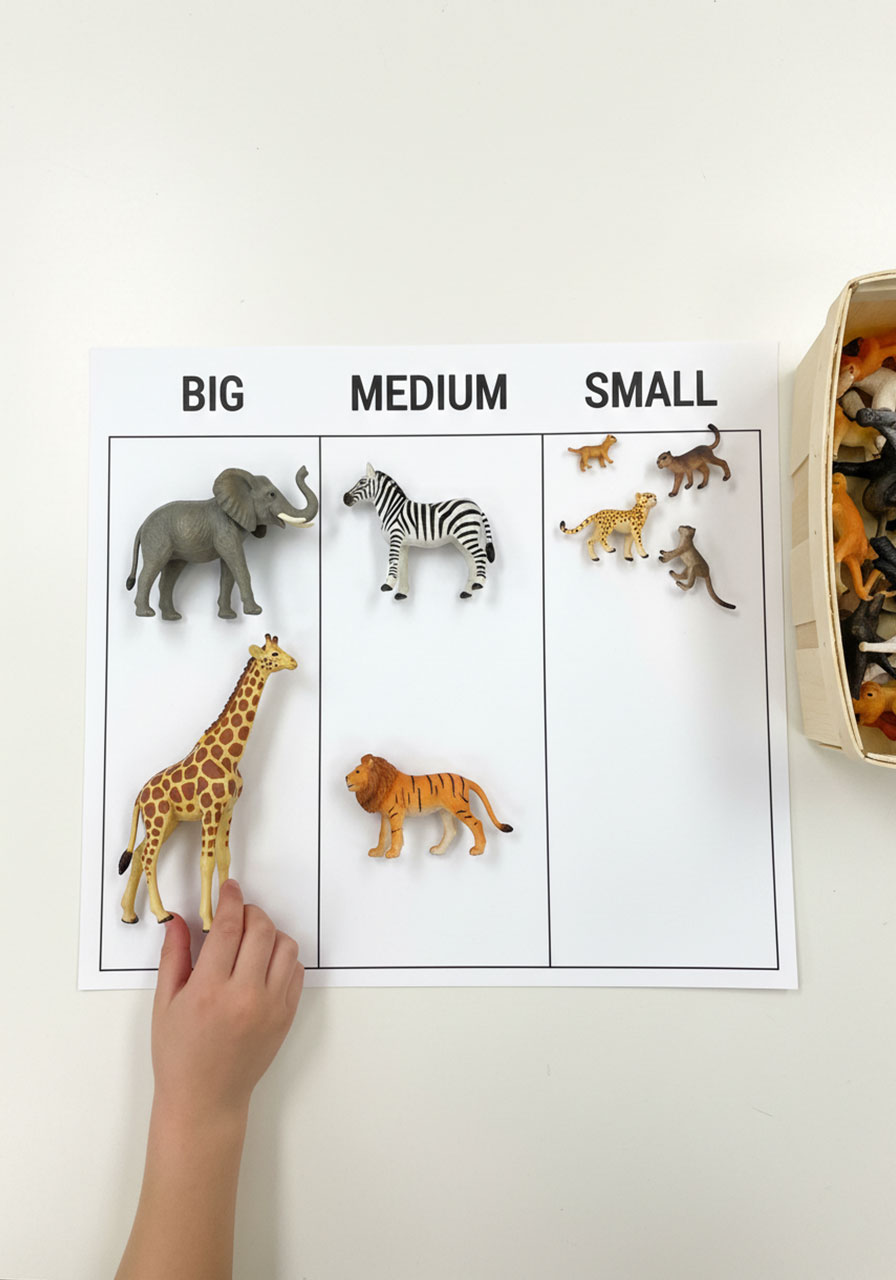
This math activity disguises learning as play – the best kind of activity!
Best for: Preschool, math concepts
Skills Developed: Size comparison, categorization, mathematical thinking
What You’ll Need:
- A variety of safari animal toys in different sizes
- A large piece of paper or poster board
- Marker to create sections
How to Set It Up:
1. Divide your paper into three sections labeled “Big,” “Medium,” and “Small.”
2. Place your basket of animals next to the sorting mat.
3. Let your child sort the animals by size. This is trickier than it sounds because kids have to compare multiple animals and make judgment calls!
Pro Tip: Once they’ve mastered three categories, challenge them to line up all the animals from smallest to biggest. Or ask questions like, “Which animal is bigger – the giraffe or the elephant?” to build comparative language skills.
8. Safari Animal Counting with Playdough
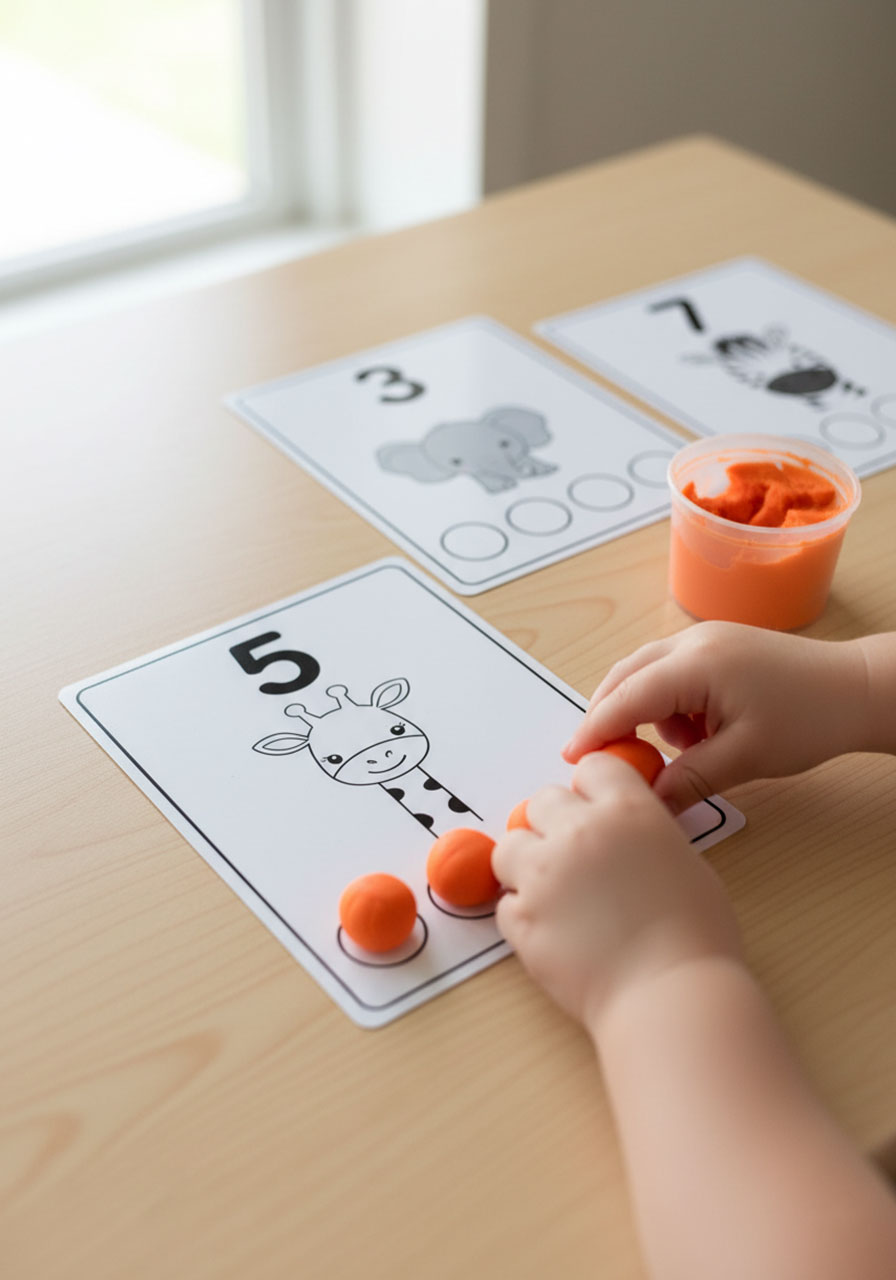
Combine sensory play with math practice in this hands-on counting activity!
Best for: Ages 3-5, number recognition and counting
Skills Developed: Counting, number recognition, fine motor manipulation, one-to-one correspondence
What You’ll Need:
- Playdough (homemade or store-bought)
- Paper with numbers and safari animals drawn on them (you can create simple versions!)
- Optional: Laminate the pages for reusability
How to Set It Up:
1. Create number cards showing numbers 1-10 with corresponding safari animals and empty spaces. For example, a card with “5” and a giraffe picture with 5 empty circles.
2. Have kids read the number and count the animals on each card.
3. Roll playdough balls to fill in the circles or create the right number of playdough pieces to match.
Pro Tip: Let the playdough warm up in your hands for a minute before giving it to younger kids – it’s easier to manipulate when it’s not cold! You can also have them roll playdough “snakes” instead of balls for variety.
9. Safari Shape Matching Challenge
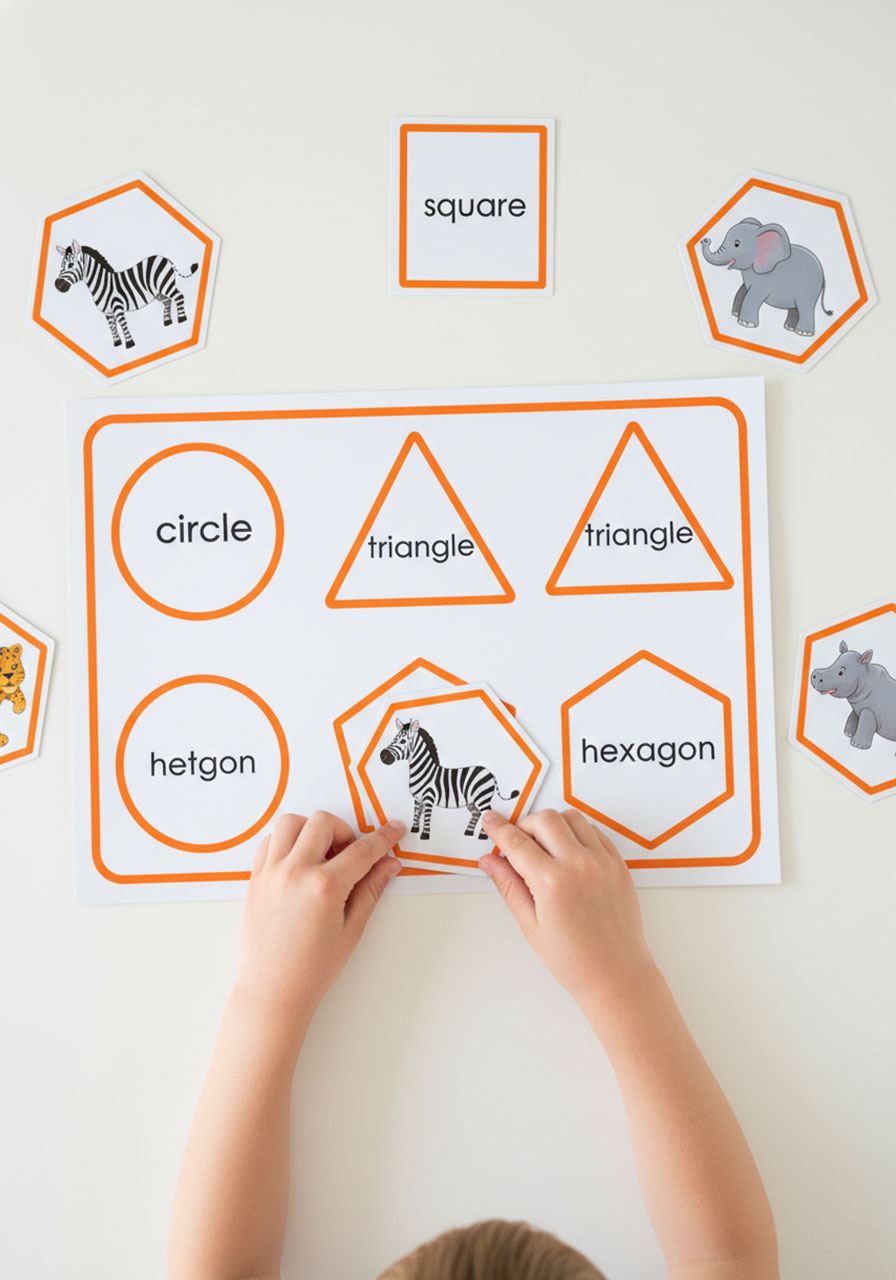
Shapes just got a whole lot more interesting with this safari twist!
Best for: Ages 3-5, shape recognition
Skills Developed: Shape identification, matching, problem-solving, visual discrimination
What You’ll Need:
- Paper or cardboard
- Markers or crayons
- Safari animal pictures (drawn or cut from magazines)
- Scissors
How to Set It Up:
1. Create a shape board by drawing 6-8 different shapes (circle, square, triangle, rectangle, pentagon, hexagon, etc.) on one piece of paper and labeling each.
2. Create matching animal cards by drawing or pasting safari animals inside the same shapes on separate pieces of paper, then cutting them out.
3. Have kids match each animal card to its corresponding shape on the board.
4. For reusable fun, laminate both the board and the cards!
Pro Tip: Start with just 3-4 basic shapes for younger kids, then add more challenging shapes like hexagons and pentagons as they master the basics. You can also use this as a cut-and-paste worksheet if you prefer!
10. Safari Fine Motor Rescue Mission

This activity looks simple but delivers a serious fine motor workout!
Best for: Ages 3-6, fine motor precision
Skills Developed: Pincer grasp, tweezers skills, hand strength, focus
What You’ll Need:
- A container
- Mini pom poms (these roll everywhere – that’s the challenge!)
- Safari animal toys
- Small tongs, tweezers, or clothespins
- Small bowls for sorting
How to Set It Up:
1. Fill your container with pom poms and hide the safari animals among them.
2. Give your child the grabbing tools and explain their mission: rescue the animals from the “swamp” without using their hands!
3. Add bowls for them to sort rescued animals or collected pom poms by color.
Pro Tip: Pom poms are intentionally tricky because they’re light and roll easily. If your child gets frustrated, switch to craft pompoms (the bigger, fluffier kind) or cotton balls. The goal is challenge, not frustration!
11. Pattern or Plain? Animal Categorization
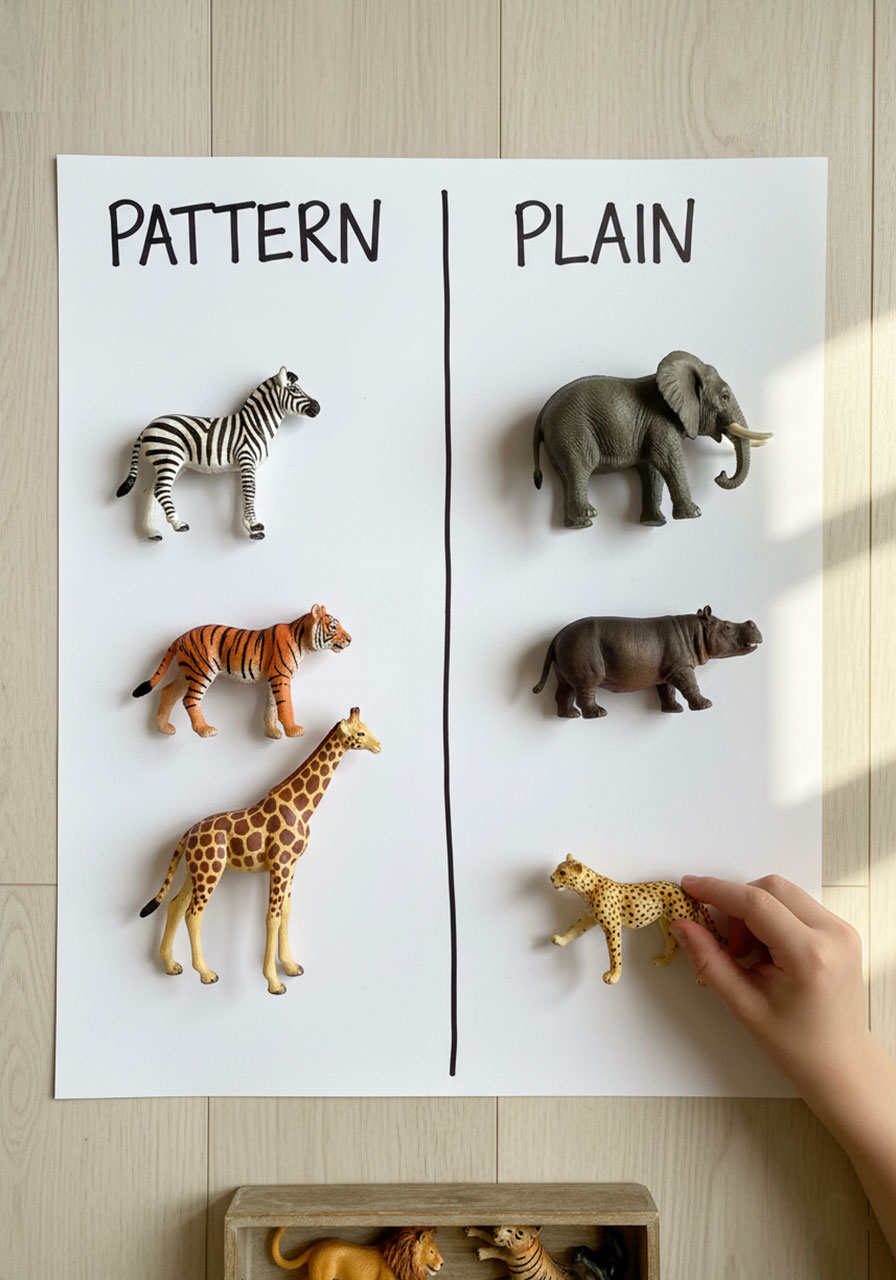
Here’s a sneaky way to teach pattern recognition that doesn’t feel like a math lesson!
Best for: Ages 4-6, pattern recognition
Skills Developed: Pattern identification, categorization, observation, visual discrimination
What You’ll Need:
- A variety of safari animal toys (aim for a mix of patterned animals like zebras, giraffes, leopards AND plain-colored ones like elephants, hippos, rhinos)
- A large piece of paper divided in half
- Marker to label sections: “Pattern” and “Plain”
How to Set It Up:
1. Divide your paper down the middle and clearly label one side “Pattern” and the other “Plain.”
2. Show your child one animal and ask, “Does this animal have a pattern on its coat or is it a plain color?”
3. Let them sort all the animals into the two categories.
4. Take it further by creating additional categories: “Spots” vs. “Stripes” for an extra challenge!
Pro Tip: This is a fantastic activity for visual learners! Talk about what makes something a pattern – repetition, multiple colors arranged in a design. You can even extend this to their own clothes: “Are you wearing a pattern today?”
12. Safari Sensory Bin for All Ages

This upgraded sensory bin works for a wide age range and stays interesting for extended play!
Best for: Ages 2-7, adaptable complexity
Skills Developed: Sensory exploration, dramatic play, fine motor skills, creativity
What You’ll Need:
- Rice (plain or colored)
- A large container
- Safari animals
- Green construction paper (cut into tree shapes or rolled into tubes)
- Optional additions: rocks, sticks, small dishes for “watering holes,” toy vehicles
How to Set It Up:
1. Pour rice into your container as the “ground.”
2. Create landscape features using rolled or cut paper for trees.
3. Add your safari animals and any other elements.
4. Provide tools like small scoops, cups, or toy vehicles for extended play possibilities.
Pro Tip: Rice can get everywhere, so do this activity on a sheet or towel that you can easily pick up and funnel the rice back into the container. Some spill is inevitable – embrace it!
13. Pattern Recognition with Real Animals

Take pattern learning beyond the sorting mat with this hands-on exploration!
Best for: Ages 4-6, advanced pattern work
Skills Developed: Pattern analysis, fine motor skills, observation, scientific thinking
What You’ll Need:
- Safari animal toys with distinct patterns (zebras, giraffes, leopards, tigers)
- Magnifying glasses (optional but awesome)
- Paper and crayons for pattern drawing (optional)
How to Explore:
1. Examine each animal closely. Look at how the stripes on a zebra are different from the spots on a giraffe or the rosettes on a leopard.
2. Talk about patterns in nature: Why might animals have these patterns? (Camouflage, recognition, etc.)
3. Try replicating patterns by drawing them or creating patterns with other materials (playdough, paint, stickers).
4. Compare and contrast: How are a tiger’s stripes different from a zebra’s? How are a leopard’s spots different from a giraffe’s?
Pro Tip: This activity bridges into early science concepts! Talk about how patterns help animals survive in the wild. It’s literacy, art, and science all rolled into one awesome activity.
Why Safari Activities Are Perfect for Fine Motor Development
Here’s the thing about safari-themed activities – they’re naturally engaging because kids love animals! When you wrap skill-building into something exciting like “rescuing animals” or “feeding hungry lions,” kids don’t even realize they’re working on crucial developmental skills.
Fine motor activities like these build the small muscle strength and coordination kids need for eventually writing, buttoning clothes, using utensils, and so many other daily tasks. The pipe cleaner unwrapping? That’s building finger strength. The tower stacking? That’s developing hand-eye coordination and spatial awareness. The sorting activities? Those are building the visual discrimination skills needed for reading.
The best part is that most of these activities use materials you already have at home or can grab at any dollar store. No fancy equipment required – just a little creativity and some toy animals!
Making the Most of Your Safari Theme Week
Whether you’re a parent doing an at-home learning unit or a teacher planning your preschool curriculum, here are some final tips to make your safari activities even more successful:
Mix it up: Rotate between active, quiet, sensory, and cognitive activities to keep kids engaged and meet different learning styles.
Follow their lead: If your kids are obsessed with one particular activity, let them repeat it! Repetition is how young children master skills.
Add safari sounds: Play safari animal sounds in the background to create atmosphere. It’s a simple touch that makes everything more immersive!
Read safari books: Pair these activities with books about safari animals to build vocabulary and knowledge. “Dear Zoo,” “We’re Going on a Lion Hunt,” and “Giraffes Can’t Dance” are favorites!
Don’t stress about mess: Sensory activities can get messy, and that’s okay! Lay down a sheet, do activities in a contained space, and remember that the learning is worth the cleanup.
With these 13 safari activities in your back pocket, you’re fully equipped to create an unforgettable learning experience that your kids will be roaring about for weeks. Time to go on a safari adventure – no plane ticket required!
More Kid’s Party Ideas to Keep the Fun Rolling:
Pass the Ice Cream: The Ultimate Sharing Game for Preschoolers
How to Make a Stunning Leaf Butterfly Craft – Easy Nature Art for Kids
10 Epic DIY Cardboard Carnival Games That’ll Make You the Hero of Any Party
Build a Name STEM Activity: The Perfect First-Week Icebreaker That Combines Literacy and Creativity
Unwrap the Alphabet: A Sneaky-Smart Fine Motor Game for Little Learners
LEGO Bridge Building Challenge: The Ultimate STEM Party Game for Kids!
Post-It Math Party: Turn Addition Practice Into an Active Game Your Kids Will Actually Beg to Play
Paper Plate Roller Coaster Challenge: The Ultimate Physics Party for Elementary Kids
