
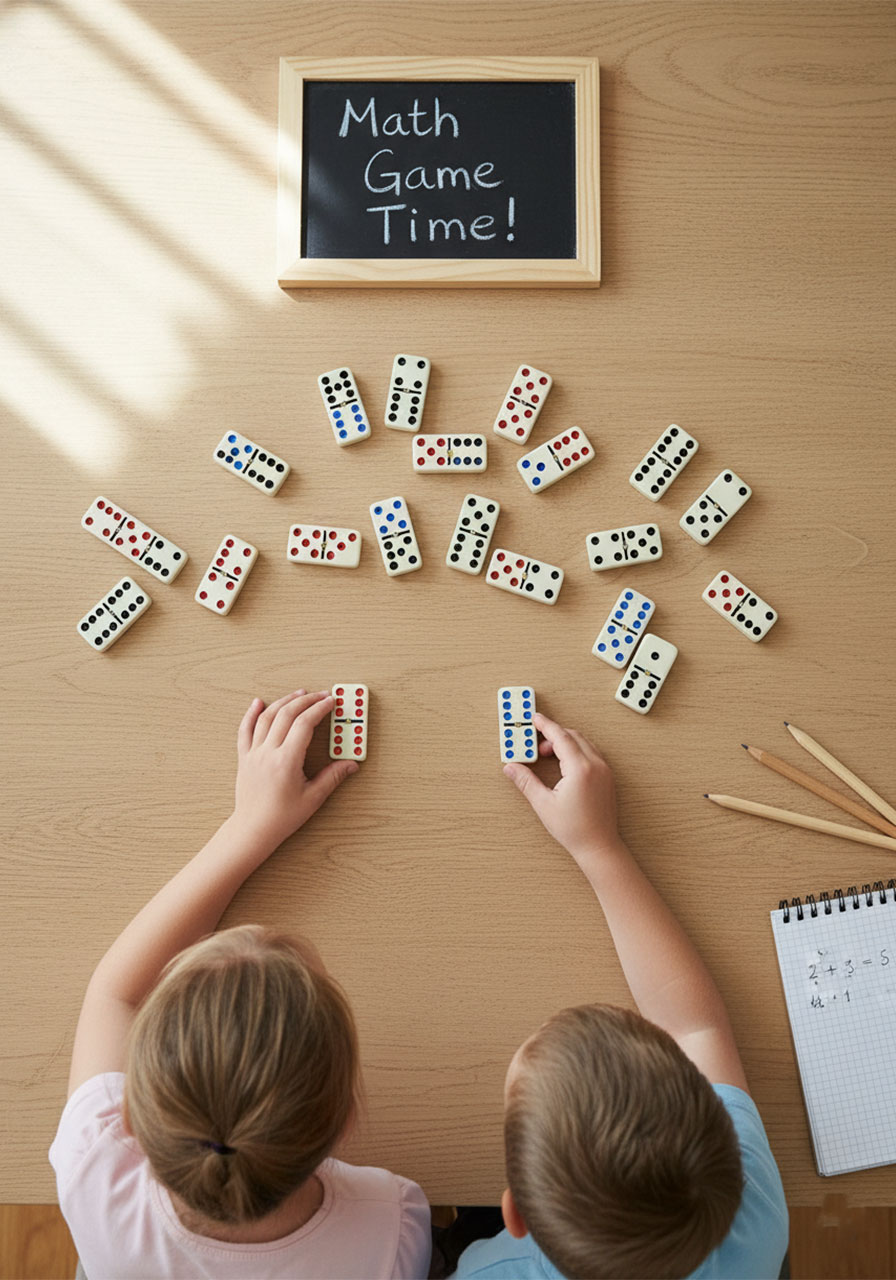
If you have a set of dominoes sitting in a drawer somewhere, it’s time to pull them out – because dominoes might just be the most underrated math manipulative you own. They’re hands-on, they’re visual, and best of all? Kids don’t even realize they’re practicing math while they play.
Whether you’re a parent looking for a rainy-day activity or a teacher hunting for a math center idea that actually holds attention, these five domino math games are simple to set up, easy to learn, and genuinely fun to play. No printables, no prep kits, no fuss – just a standard set of dominoes and a little friendly competition.
Let’s dive in!
Game 1: Domino Keepers – Addition
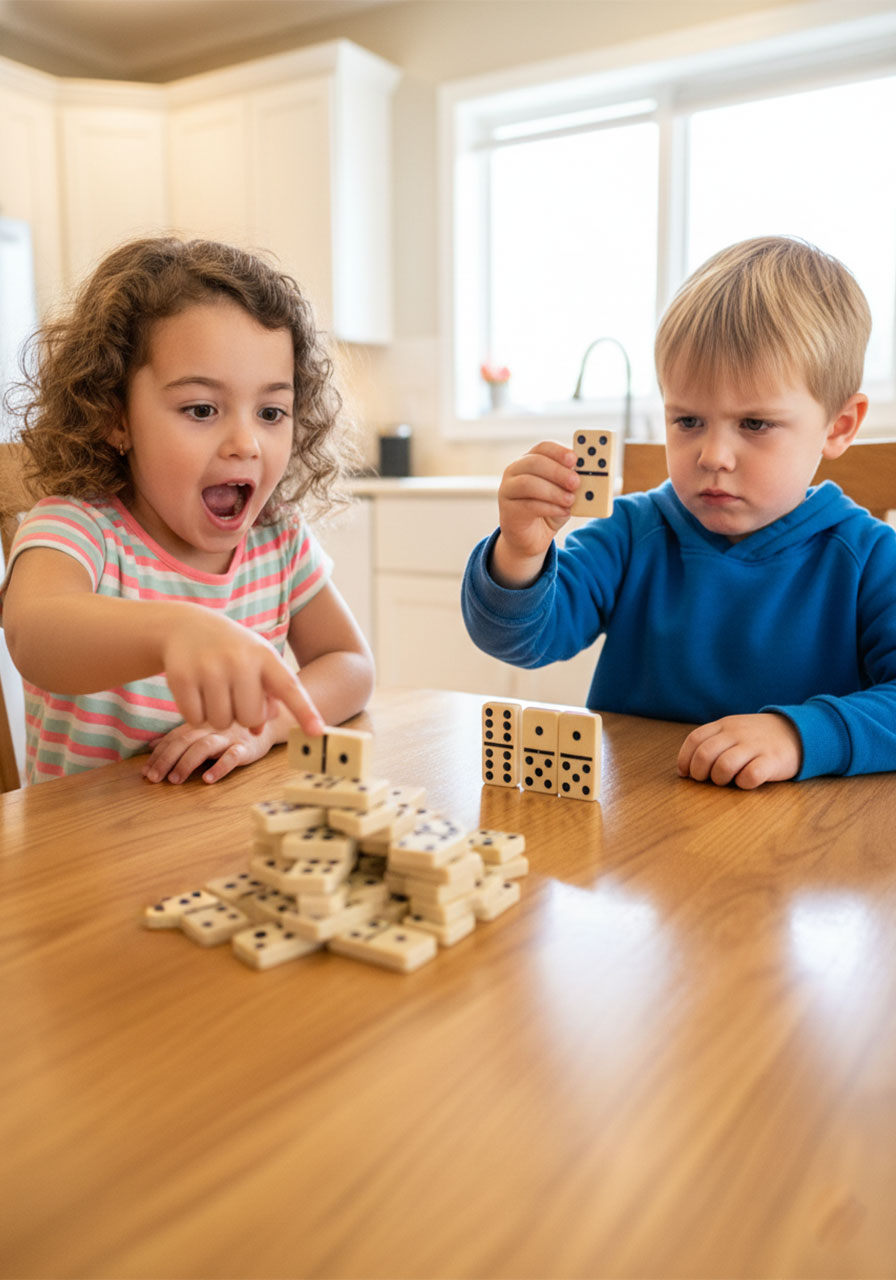
This is the gateway domino math game, and once kids try it, they’ll be asking to play it again and again. It’s fast, competitive, and gives addition practice a satisfying payoff – because winning dominoes feels a lot better than filling in a worksheet.
Best for: Ages 5–9 | Early addition practice
Players: 2 (or 2 small teams)
Time to Play: 10–15 minutes
What You’ll Need:
1 standard set of dominoes
How to Play:
1. Place all the dominoes face-down in the center of the playing area and mix them up.
2. Both players reach in and each flip over one domino at the same time.
3. Each player adds up the two numbers on their domino and says the equation out loud – for example, “3 + 5 = 8.”
4. The player with the higher sum wins both dominoes and sets them aside in their own pile.
5. If both players flip dominoes with the same sum, it’s a tie – each player keeps their own domino.
6. Keep going until all the dominoes have been flipped. The player with the most dominoes at the end wins!
Pro Tip: Have younger kids use a number line or their fingers to work out the sums – speed isn’t the point here, accuracy is. For a classroom setting, this makes a perfect partner math center with zero setup time.

Game 2: Domino Keepers – Multiplication

Already mastered addition? Level up with the exact same game, but this time players multiply instead of add. The rules are identical – which means kids can learn this one in about 30 seconds flat. It’s a brilliant way to sneak in times table practice without the dreaded flashcard drill energy.
Best for: Ages 8–12 | Multiplication fluency
Players: 2 (or 2 small teams)
Time to Play: 10–15 minutes
What You’ll Need:
1 standard set of dominoes
How to Play:
1. Place all dominoes face-down in the center and mix them up.
2. Both players flip one domino at the same time.
3. Each player multiplies the two numbers on their domino and says the equation out loud – for example, “4 × 6 = 24.”
4. The player with the higher product wins both dominoes.
5. If both products are equal, each player keeps their own domino.
6. Play until all dominoes are gone. Most dominoes wins!
Pro Tip: Watch what happens when a player draws a domino with a zero – suddenly “6 × 0 = 0” becomes a very real (and very dramatic) lesson in the zero property of multiplication. It’s one of those lightbulb moments that sticks.
Game 3: Domino War – Comparing Numbers
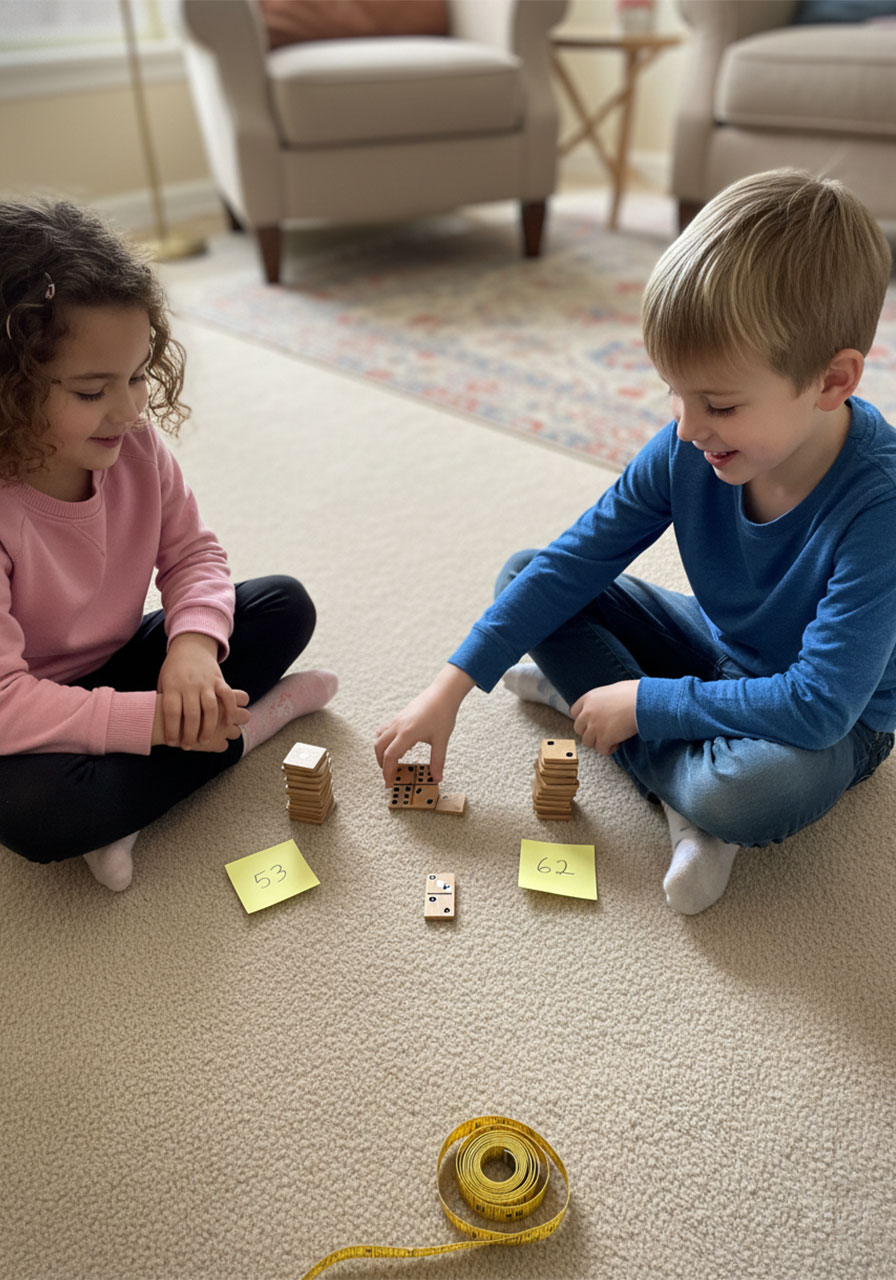
Think of this as the classic card game War, but with a domino twist that sneaks in a surprisingly meaty math concept: comparing two-digit numbers. Kids have to think about place value to figure out who wins each round, and it sparks great conversations about which number is actually bigger and why.
Best for: Ages 6–10 | Place value, comparing numbers
Players: 2
Time to Play: 10–20 minutes
What You’ll Need:
1 standard set of dominoes
A piece of paper and pencil (optional, for writing numbers)
How to Play:
1. Divide all the dominoes equally between two players, face-down in separate piles.
2. On the count of three, both players flip their top domino.
3. Each player looks at their domino and creates a two-digit number using the two sides – and here’s the strategic twist: they get to choose the order! A domino showing 3 and 5 could become 35 or 53. Choose wisely!
4. Each player announces their two-digit number out loud.
5. The player with the larger number wins both dominoes.
6. In the case of a tie, each player flips one more domino and the higher number from that round takes all four.
7. The player with the most dominoes at the end wins.
Fun Variation: For a challenge, tell players they must create the smallest possible number from their domino each round instead of the largest. Suddenly 53 becomes 35, and kids have to think in a whole new direction!
Game 4: Domino Fractions Match-Up

Here’s one that gets a little more interesting – and a lot more visual. Dominoes are basically fractions waiting to happen. That line in the middle? That’s a fraction bar. This game uses that built-in structure to help kids see fractions as real, concrete numbers they can compare and even order – no abstract symbols needed.
Best for: Ages 8–12 | Fractions, comparing fractions
Players: 2–4
Time to Play: 15–20 minutes
What You’ll Need:
1 standard set of dominoes (remove any dominoes with a blank side for this one)
Paper and pencil for each player
How to Play:
1. Place all dominoes face-down in the center. Remove any that have a blank (zero) end, since zero can’t be a denominator.
2. Each player draws 5 dominoes and keeps them hidden from the other players.
3. Each player looks at their dominoes and decides which end will be the numerator (top) and which will be the denominator (bottom) – again, the goal is to make the largest fraction possible.
4. On the count of three, all players reveal their best domino-fraction.
5. Players say their fraction out loud – for example, “5 over 2” or “4 over 3.” The player with the largest fraction wins all the revealed dominoes that round.
6. Players draw back up to 5 dominoes from the center pile each round. Play until the center pile is gone. Most dominoes wins!
Pro Tip: Before playing, do a quick review of what makes a fraction bigger or smaller – a larger numerator and a smaller denominator is the winning combo. This becomes a real “aha!” moment during play when kids realize 5/2 beats 3/1 by a lot!
Game 5: Domino Number Bond Builder
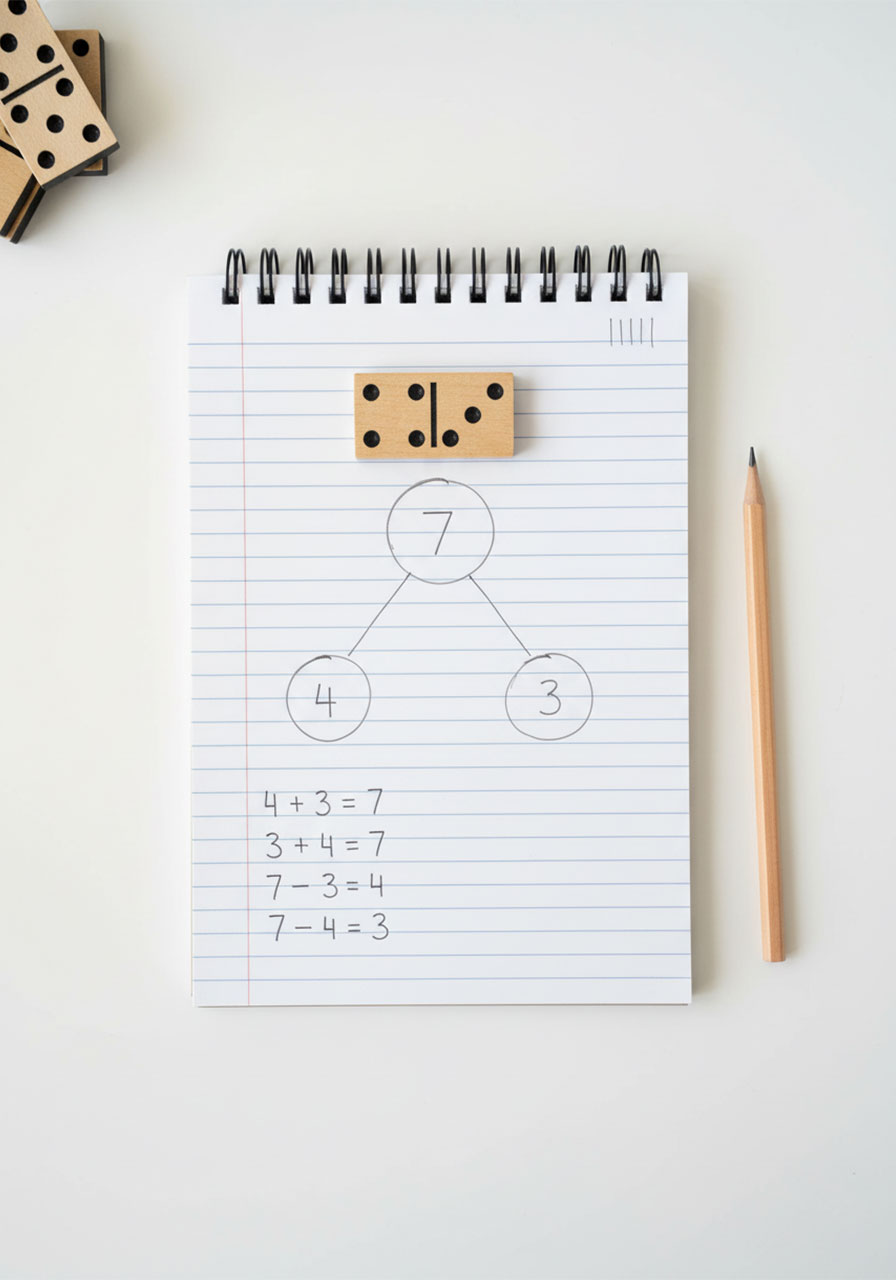
This one is a little quieter and more collaborative – perfect for winding down a lesson or for kids who need a bit more think time. Number bonds (the idea that a number can be broken into two parts) are a foundational math concept, and dominoes illustrate them perfectly. Each domino IS a number bond, just waiting to be named.
Best for: Ages 5–8 | Number bonds, part-whole relationships
Players: 1–4 (works great as solo practice too!)
Time to Play: 10–15 minutes
What You’ll Need:
1 standard set of dominoes
Paper and pencil for each player
How to Play:
1. Place all dominoes face-down and mix them up.
2. Each player draws one domino and looks at the two numbers on it.
3. The player writes a complete number bond on their paper: the two parts (the dots on each side) and the whole (the total when added together). For example, a domino showing 4 and 3 would produce the number bond: parts = 4 and 3, whole = 7.
4. Players also write both addition facts that come from their number bond: 4 + 3 = 7 and 3 + 4 = 7. Bonus points if they can write the two subtraction facts too: 7 − 3 = 4 and 7 − 4 = 3.
5. Score 1 point for each correct number bond. Score a bonus point for correctly writing all four related equations.
6. Draw a new domino and repeat. Play for a set number of rounds (try 5 or 10). Most points wins!
Pro Tip: For classroom use, this is a fantastic independent warm-up activity. Set a timer for 5 minutes at the start of math class and let kids quietly work through as many dominoes as they can. It gets their brains in “math mode” before the lesson even starts.
Why Dominoes Are Such a Great Math Tool
There’s a reason teachers have been reaching for dominoes for decades – they’re one of the few manipulatives that work equally well for a first grader learning to count and a fifth grader wrestling with fractions. The dots are concrete, the numbers are visible, and the game format means kids are motivated to keep going.
Best of all, a single set of dominoes can fuel weeks of math practice without ever feeling repetitive. Rotate through these five games and watch your kids (or students) build number confidence one tile at a time.
Now go dig out those dominoes – it’s game time!
More Kid’s Party Ideas to Keep the Fun Rolling:
The Coolest Morse Code Activity for Kids (Using Lego!)
The Straw Maze Activity Kids Will Beg to Play Again and Again
7 Fun Hand-Clapping Games Kids and Adults Will Absolutely Love
DIY Robot Hand: The STEM Activity That’ll Make Kids Say ‘Whoa!’
DIY Toilet Roll Knitting for Kids: The Ultimate Beginner Craft That Actually Works
11 Ridiculously Simple Fine Motor Activities That’ll Keep Toddlers Busy for Hours
