

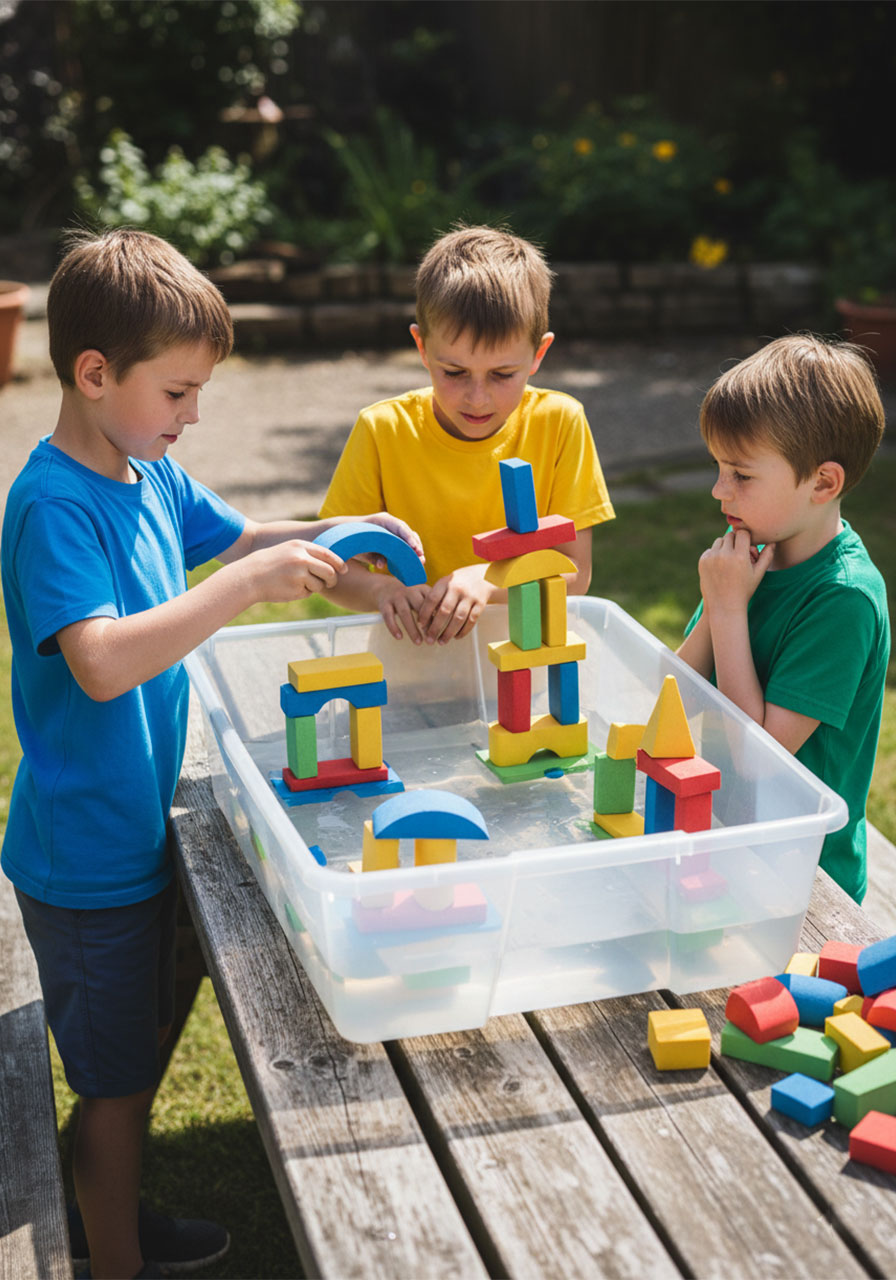
Here’s a challenge your little engineers are going to absolutely love: build a city – and make it float. This Floating City STEM challenge is one of those magical activities that looks simple on the surface but quietly packs in a ton of science, problem-solving, and pure hands-on fun. All you need is a plastic tub, some water, and a set of foam blocks. The result? An afternoon of splashing, building, experimenting, and a whole lot of “wait, why did THAT fall down?”
This is a perfect STEM activity for preschoolers and kindergarteners, but honestly? Older kids get just as hooked. The challenge naturally scales in complexity as kids grow – which means it’s a go-to you’ll come back to again and again.
Adult supervision is required at all times during this activity.
Why This Activity Is So Great for Kids
Before we dive in, here’s the science magic happening behind the scenes. When foam blocks get wet, surface tension causes them to stick lightly together – which means kids can actually stack and connect them to build structures that float. But here’s the twist: the water in the tub moves, creating tiny waves that make the base of any building unstable.
That’s the engineering challenge. How do you design a building that can handle a wobbly, wave-filled foundation? Kids will naturally start experimenting – making bases wider, trying different shapes, building bridges between structures – without even realizing they’re doing real engineering thinking. It’s learning disguised as play, and it’s brilliant.
This activity builds:
Critical thinking – kids observe what works and what doesn’t, then adjust
Structural engineering basics – stability, balance, and foundation design
Problem-solving skills – every collapse is just data for the next attempt
Fine motor skills – placing wet foam blocks carefully takes real hand control
Science concepts – surface tension, buoyancy, and cause-and-effect
What You’ll Need
A large plastic storage tub (the bigger, the better – more room to build!)
Water
A set of foam building blocks
Pro Tip: Don’t have foam blocks? This activity also works brilliantly at bath time. Toss the foam blocks into the tub and let the kids engineer away during their next bath. Bonus: it makes getting in the tub a lot more exciting.

How to Set Up the Floating City Challenge
Step 1: Fill Your Tub with Water
Fill your large plastic container with about 2–3 inches of water. You don’t need it deep – just enough that the foam blocks can float freely and the water can move around. Set it outside on a flat surface (a patio or backyard is perfect, because things are going to get splashy).

Step 2: Add the Foam Blocks
Drop all your foam blocks into the water and let the kids explore for a minute. Let them notice that the blocks float, that they stick together when wet, and that the water sloshes and moves. This free-play discovery moment is important – kids are already forming hypotheses before the challenge even officially starts.

Step 3: Issue the Challenge
Now for the fun part. Pose the engineering challenge to your kids:
“Can you build a city that stays standing – even when the water makes waves?”
Let them go for it! Here are some questions to spark their thinking as they build:
“What happens if you make the base wider?” – encourage them to try a wide, flat foundation vs. a tall, narrow one and see which survives the waves longer.
“How high can you build before it falls?” – challenge them to go taller and observe the tipping point.
“Can you build a bridge between two separate structures?” – this introduces a new engineering problem: how do you connect two floating foundations?
“What shapes make the most stable base?” – squares, rectangles, and wide flat blocks tend to work better than cylinders or triangles at the base.

Step 4: Experiment, Fail, Rebuild
Here’s where the real learning happens. When a building collapses – and it will – celebrate it! Every collapse is a clue. Encourage kids to ask “why did that fall?” before rebuilding. Did the base shift? Was it too tall? Did the waves hit it at the wrong angle?
Older kids can be challenged to build an entire floating city – multiple buildings, roads, or bridges connecting them. Younger kids will be perfectly happy watching towers dramatically crash into the water and trying again. Both are wins.

Tips for Teachers and Parents
For toddlers and preschoolers (ages 2–4): Keep the focus on free exploration. Let them simply stack, knock down, and splash. The concepts will absorb naturally through play.
For kindergarteners (ages 5–6): Introduce the concept of a “design challenge” – ask them to plan their city before building, then compare the plan to what actually works.
For older kids (ages 7+): Add rules to increase complexity. Try: “Your city must have at least 3 buildings and one bridge” or “You have only 20 blocks – use them wisely.”
For classroom use: Split kids into teams and give each team identical sets of blocks. Who can build the tallest structure that survives 30 seconds of “wave testing” (gently rocking the tub)? It becomes a friendly competition that drives incredible engagement.
The Science Behind It (For the Curious Adults in the Room)
Want to explain what’s happening to your kids in simple terms? Here’s how to break it down:
Why do wet foam blocks stick together?
Water molecules are attracted to each other and to the foam surface. When two wet blocks touch, the water between them creates a weak bond – enough to hold lightweight structures together, but not enough to withstand big forces. That’s surface tension at work!
Why does the city fall down?
The water in the tub isn’t perfectly still – any movement creates small waves. These waves push against the base of the structure from the sides, making it rock. If the base is too narrow or the structure too tall, the rocking force topples the building. Engineering solution: make the base wider to lower the center of gravity and spread the force.
More STEM Challenges Your Kids Will Love
If your little engineers are hungry for more, here are some other hands-on STEM challenges perfect for preschoolers and early elementary kids:
DIY Magnetic Ball Run
Building Shapes – STEM for Kids
Parachute STEM Experiment
STEM Challenge: DIY Pirate Ship
Building with Straws – STEM Challenge
Build a Paper Chain
The Floating City challenge is one of those activities that’s easy to set up, impossible to mess up, and genuinely exciting for kids at every stage. Whether it’s a sunny afternoon activity in the backyard, a rainy-day bath time experiment, or a classroom engineering challenge, it delivers every single time. Set it up once and watch the curiosity take over – your kids will be the ones begging to do it again.
Happy building!
More Kid’s Party Ideas to Keep the Fun Rolling:
Dot Sticker Addition: The Hands-On Math Activity Kids Actually Want to Do Again and Again
Water Gun Painting: The Most Fun Kids Art Activity This Summer
How to Make a LEGO Sundial: A Hands-On Science Activity Kids Will Love
Rabbit Hole: The Hilarious Gross Motor Group Game Kids Will Beg to Play Again
How To Make a Tissue Box Toy Car Wash (The Easiest $0 Craft That Kids Go Absolutely Wild For)
Shaving Cream Sensory Play: The “Decorate the Cake” Activity Kids Go Absolutely Wild For
Q-Tip Push: The Crazy-Simple Baby Activity That Buys You 30 Minutes of Peace
The Muffin Tin Letter Sounds Activity That Makes Learning ABCs Actually Fun
